

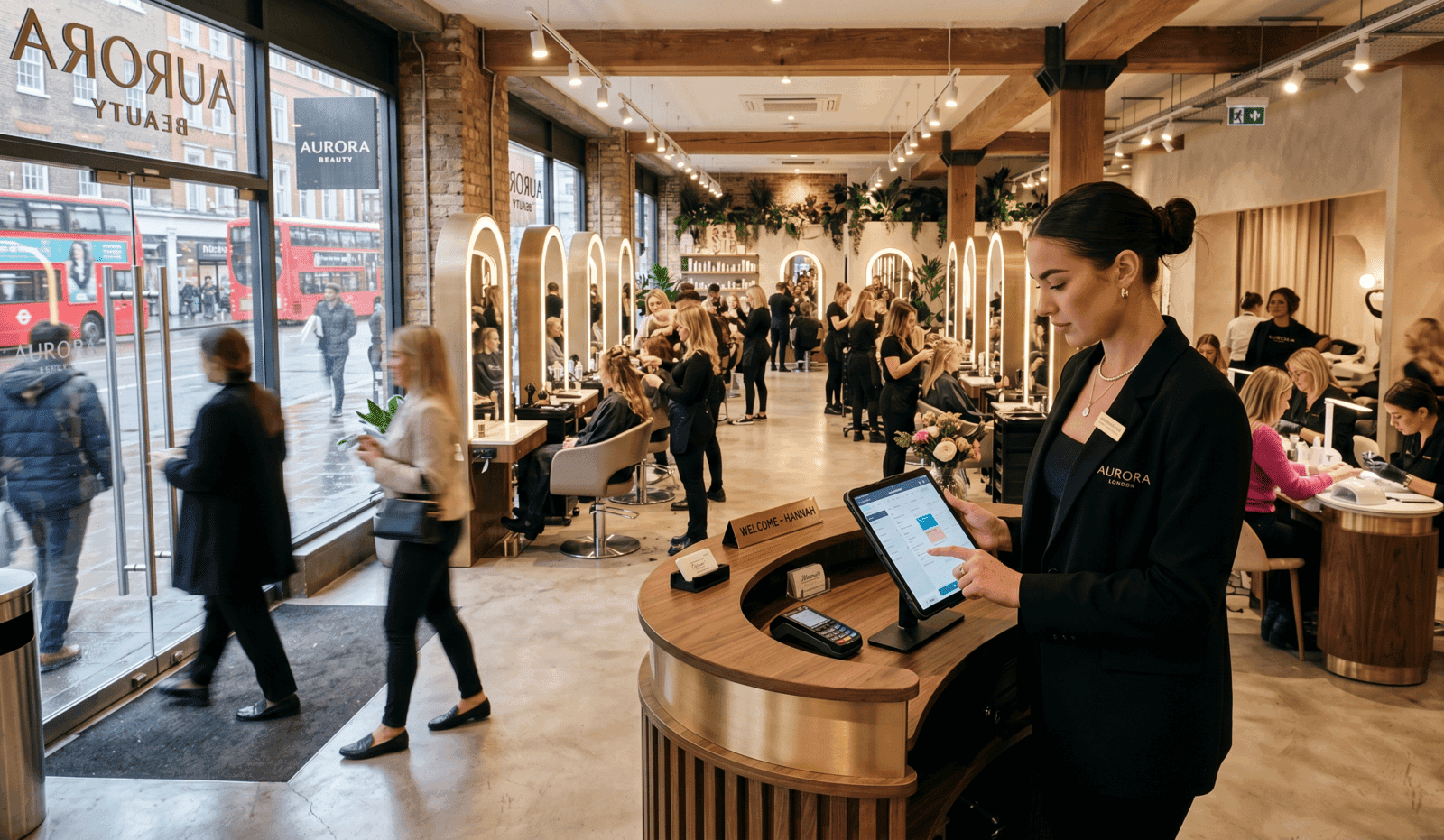
Why do walk-in clients leave before being served?
Walk-in clients leave before being served because uncertainty about the wait feels worse than the wait itself. When someone can't answer "how long?" and "who will I get?", they make a fast risk calculation, and most of them make it quietly, without telling you.
Research into customer queuing behaviour shows that uncertainty about wait duration is a stronger driver of abandonment than actual wait length. A client who knows they're third in line for a specific stylist will wait longer than a client who sees two people sitting and has no idea what that means for their own wait.
The problem is worse at the door than inside. Just like in barbershops or restaurants, a crowded reception area is a pre-entry deterrent. Walk-in clients assess the situation before committing, and without visible information, they default to worst-case assumptions.
How much do salon walk-aways actually cost?
Walk-in clients who leave before sitting down represent pure lost revenue with no record. There's no booking cancellation, no complaint, no trace. According to a Square Beauty Industry Report, 62% of walk-in clients will leave if they're told to wait more than 15 minutes with no visibility into when they'll be served. The issue is not the 15 minutes. It's the "no visibility."
At a salon doing 30 walk-ins on a busy Saturday, even a 15% walk-away rate is 4 or 5 clients gone. At an average service value of $50, that's $200 to $250 in a single day, or roughly $10,000 a year from one busy day per week alone.
Most salon owners don't track this number because they can't. Clients who leave don't show up in any report. That's part of why the problem persists.
The five reasons walk-in clients leave (and how to reduce walk-aways from each)
Understanding where the drop-off happens helps you fix the right thing. Walk-aways almost always come from one of these five causes.
| Reason | What the client experiences | What's actually happening |
| No acknowledgment at the door | Walks in, no one looks up | Staff are focused on chairs, door goes unmanaged |
| No time estimate given | "It'll be a while" or silence | Staff genuinely don't know, or don't want to commit |
| Can't choose a stylist | "Whoever is next" | No per-stylist queue visibility |
| Lobby feels too crowded | Three people sitting, no movement visible | No information, clients filling the space physically |
| Can't wait outside | Must stay present to keep their place | Paper list or verbal system with no notifications |
Each one of these is fixable. None of them require hiring more people or redesigning your space.
Does telling walk-ins their wait time actually keep them?
Yes, and the research is consistent on this. Zenoti's 2023 survey of over 1,500 beauty and wellness clients found that 51% of barbershop clients and 42% of salon clients named waiting around as their most frustrating in-store experience. The frustration isn't the wait itself. It's not knowing.
A client told "you're third, probably 25 minutes" will almost always stay. The same client told nothing will often leave before the 10-minute mark.
This is the core of the walk-away problem: salons that don't communicate wait information assume that clients will ask if they need to know. Most clients don't ask. They leave.
Why a paper sign-in sheet doesn't solve the problem
A paper list does one thing: it records that someone arrived. It doesn't tell the client how long they'll wait, which stylist they'll get, or when their turn is coming. It also ties clients to the waiting area, since leaving means losing their place.
The result is a crowded lobby full of people watching the clock, interrupting staff with "how much longer?", and making a decision to leave the moment the wait starts to feel unpredictable.
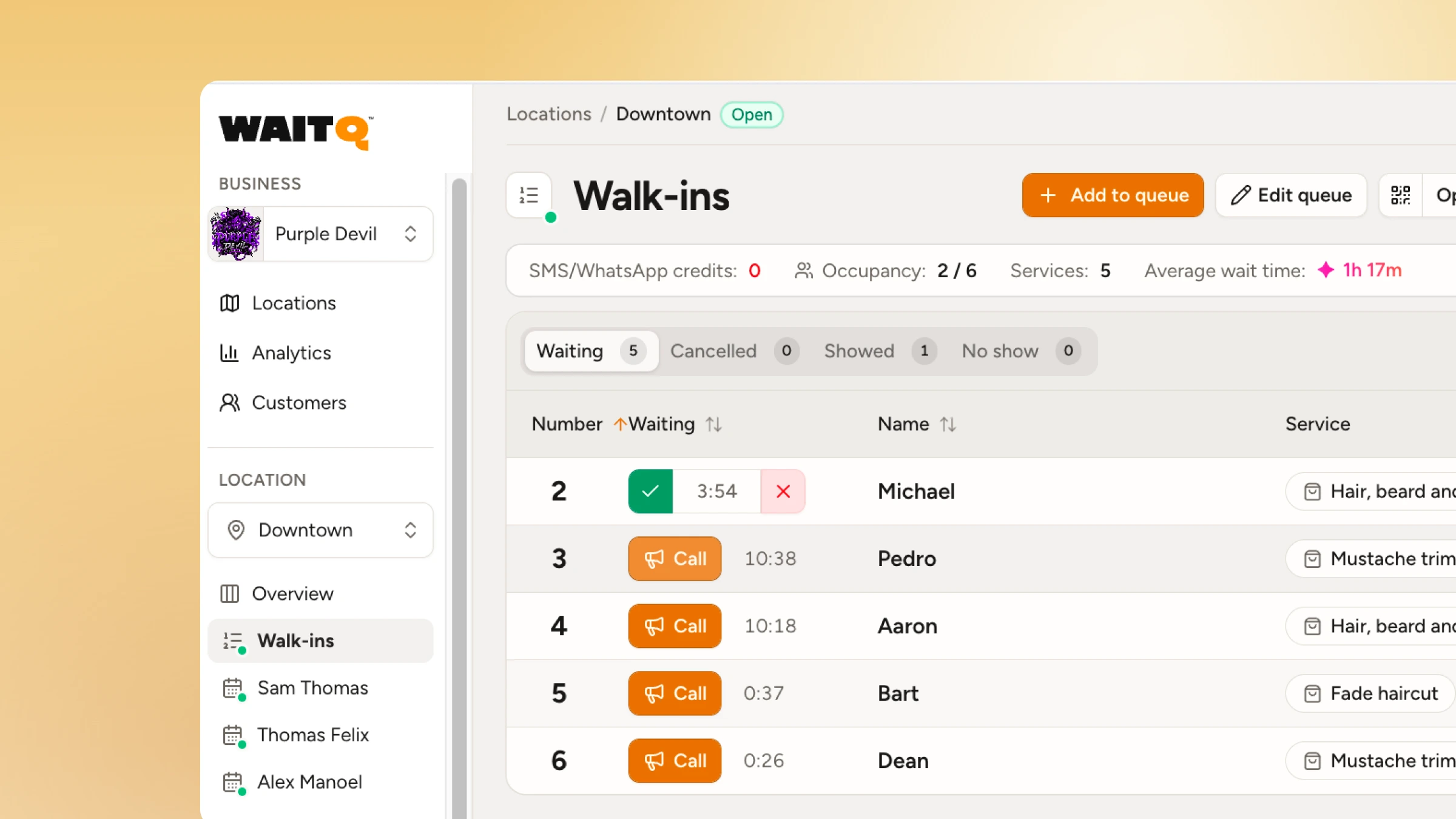
A digital waitlist solves the tethering problem. Clients join via QR code, see their position in real time, and can wait anywhere. They only need to be back when it's almost their turn. That frees up your reception area and removes the pressure that makes waits feel chaotic.
How QR code self check-in prevents the first walk-away trigger
The first walk-away trigger is the door moment: a client walks in, no one acknowledges them, and they have to interrupt a busy member of staff to find out if they can even be seen today.
Self check-in via QR code removes that friction entirely. A client scans a code at the entrance, enters their name and service, picks their preferred stylist, and they're in the queue. The whole process takes about 30 seconds. They immediately see their position and an estimated wait time, without speaking to anyone.
For your staff, it removes the constant door-management task during peak hours and lets them focus on the clients already in chairs.
What happens when clients can wait outside the salon?
When clients aren't tethered to your waiting area, two things improve: the lobby clears, and the wait feels shorter. A crowded reception area is its own walk-away trigger. New arrivals see a full room and assume a long wait. Existing waiters feel trapped and anxious. Research on wait psychology consistently shows that occupied, mobile waiting feels shorter than static, visible waiting.
SMS and WhatsApp notifications are what make mobile waiting possible. They can be at the café next door, in their car, or running an errand nearby. Your lobby holds three people instead of twelve, and the three people there are calm and comfortable rather than anxious.
Making the wait visible with a queue display
A live queue display on a screen near your entrance does something that verbal updates can't: it runs continuously without requiring any staff attention.
Clients who can see the queue moving, their name getting closer to the top, and the current wait time don't need to ask. The anxiety that drives "how much longer?" questions drops significantly, and so does the number of interruptions your front desk handles during busy periods.
The display also works as a pre-entry signal. A client who glances through the window and sees a visible, moving queue is more likely to come in than one who sees an opaque waiting area with no information.
How WaitQ reduces salon walk-aways
WaitQ is built around the specific problem this post describes: clients leaving before they sit down because the wait is invisible.
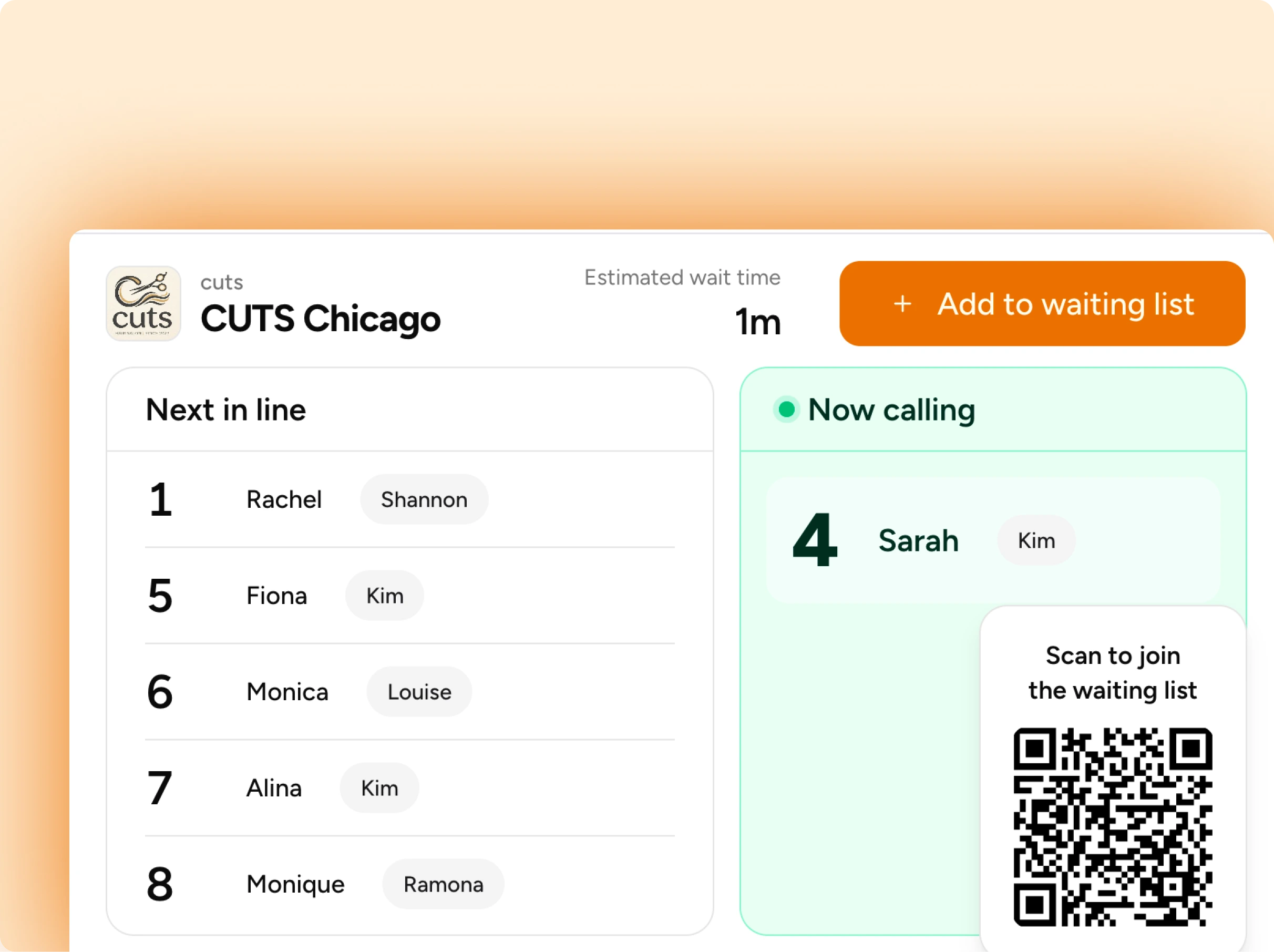
Clients check in via QR code at your entrance, choose their service and preferred stylist, and join the live queue. They see their position immediately. When their stylist is ready, one tap from the staff sends an SMS or WhatsApp notification. A public display on any screen shows the current queue so clients know their status without approaching the front desk.
For salons running both walk-ins and appointments, WaitQ keeps the two streams separate and visible. The app works on any existing device, takes about five minutes to set up, and doesn't require clients to download anything.
Try it on your next busy day and track how many clients check in versus how many actually sit down.
Turning the wait into a better salon experience
A walk-in client who is comfortable, informed, and free to move around is in a better mood when they sit down. That affects the consultation, the service, and whether they rebook before leaving. Salons with strong retention don't just do better hair. They manage the full experience from the moment someone arrives, including the part before the service starts.
The tools to do this are not expensive or complicated. Most salons that fix their walk-away problem do it with a QR code, a screen, and a notification system. The investment is small, the ROI is huge.
