

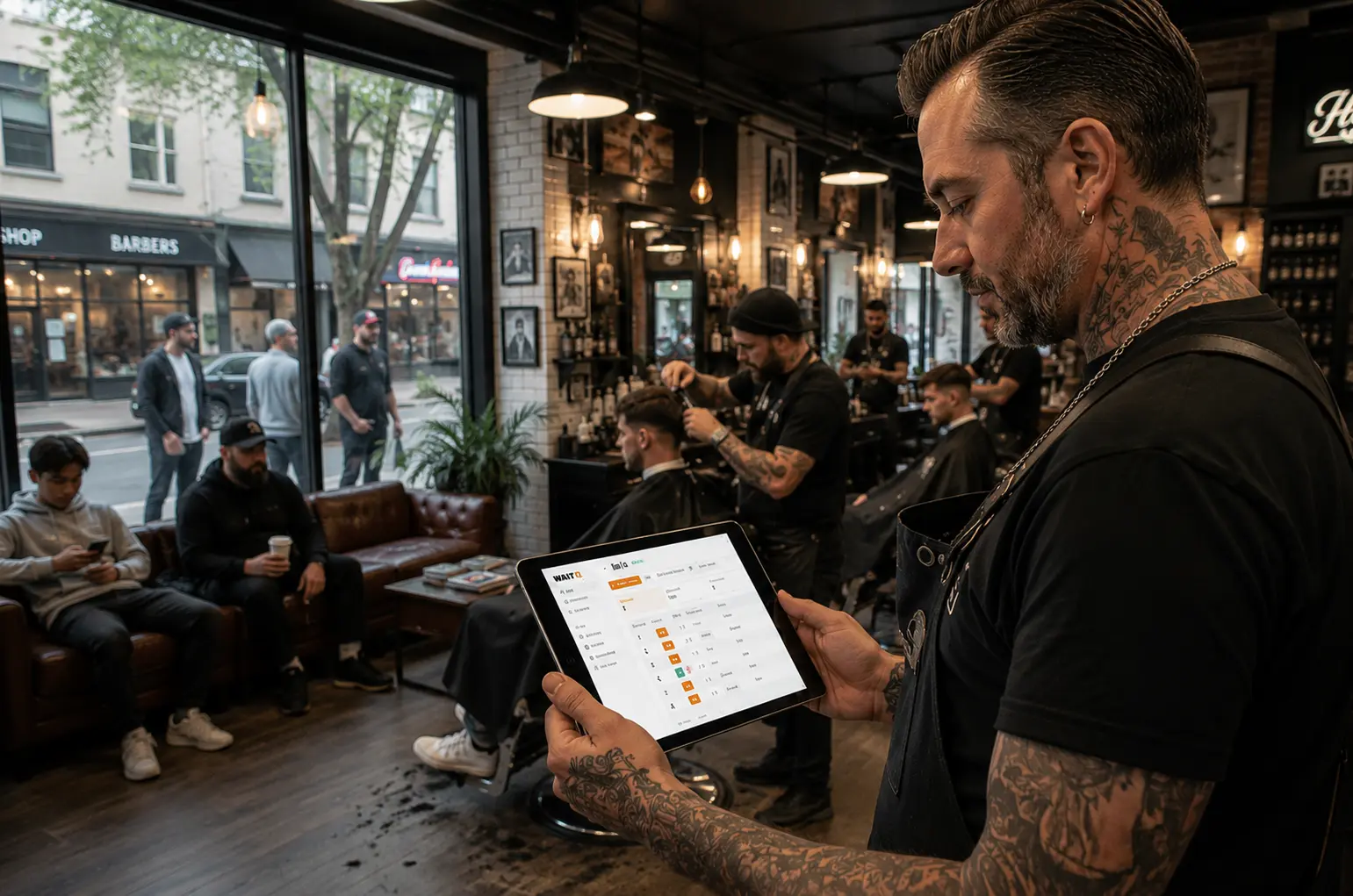
Unlike salons, where appointments are the default model, barbershops are more built around the walk-in culture. Zenoti found that 35% of barber shop clients walk in "usually or always," meaning up to a third of your foot traffic arrives with no prior commitment and no loyalty anchor beyond the experience you give them on the day.
Walk-ins are also the most fragile part of the business. A client who arrives, looks at the situation, can't read how long the wait will be, and quietly leaves, is revenue you never see. No complaint, no record, no second chance. Moreover, most barbershop clients get around 7 haircuts annually which means every walk-away is potentially not 1, but 7 visits that year, making the cost of poor queue management visceral.
The research backs this up. Uncertainty increases perceived wait time, and visible queues discourage entry even when the actual wait is reasonable. A 10-minute wait with no information feels worse than a 20-minute wait where the client knows exactly where they stand.
Why do barbershop walk-in clients leave?
Walk-in clients leave because of uncertainty, not because the wait is too long. Research into customer behaviour shows that visible queues discourage entry even when those queues are moving fast: customers judge a line by its length, not by how quickly it moves. When someone walks into your shop and can't immediately answer two questions ("How long?" and "Who will I get?"), they start running a risk calculation in their head. Most of them won't ask. They'll assess the room, make a quiet decision, and leave.
The fix isn't a shorter wait, but rather a legible wait. Tell clients where they are, who they're waiting for, and roughly how long. That single change is where most walkout reduction comes from.
The basics every barbershop should have in place first
Before looking at any software, there are low-cost changes that make a real difference in how clients experience the wait. These apply to any shop, regardless of volume.
- Acknowledge every walk-in immediately. The moment someone steps through the door, they should know they've been seen. A nod, a "with you in a second," or a quick "grab a seat, you're looking at about 20 minutes" costs nothing. Research suggests that clients who are acknowledged when they arrive are significantly less likely to leave.
- Give a specific time estimate, always. "About 20 minutes" beats silence every time. You don't need to be precise, you need to be honest. Clients will wait longer than they expected if they were told up front. They won't wait at all if they were told nothing.
- Make the wait comfortable. Proper seating (not folding chairs), free Wi-Fi, a charging point, and something on the screen all help. If you have a TV showing sports or a live queue display showing who's next, clients settle in instead of hovering near the door.
How to run per-barber queues
Why does barber loyalty change how you need to manage your queue?
Barber loyalty is the dynamic where a client wants a specific barber, not just the next available chair. This is more common in barbershops than in hair and beauty salons, and it changes the logic of queue management entirely.
In a barbershop, a regular who comes in for their usual barber will wait longer for that specific person than they would for anyone else, but that also means they won't join a general queue where they don't know who they'll end up with.
A single shared queue, where clients just wait for "the next available," doesn't match how most barbershop clients act. The right approach is per-barber queues, where each barber has their own waiting list. Clients pick their barber when they check in and join that specific list. They can see their position in that barber's queue, not just a general shop-wide count.
The operational benefit is real: barbers get better visibility into their own day, walk-ins are routed accurately, and clients feel like they have a plan rather than a gamble.
Can a barbershop run walk-ins and appointments at the same time without chaos?
Yes, and the most effective approach is keeping the two streams in separate but visible lanes rather than merging them into one queue. Appointments anchor the schedule, walk-ins fill the gaps.
The problem is that without clear visibility, those two streams collide, barbers lose track of who's next, and clients on both sides feel like they're being jumped. Software like WaitQ allows you to manage the entire client flow from a single dashboard.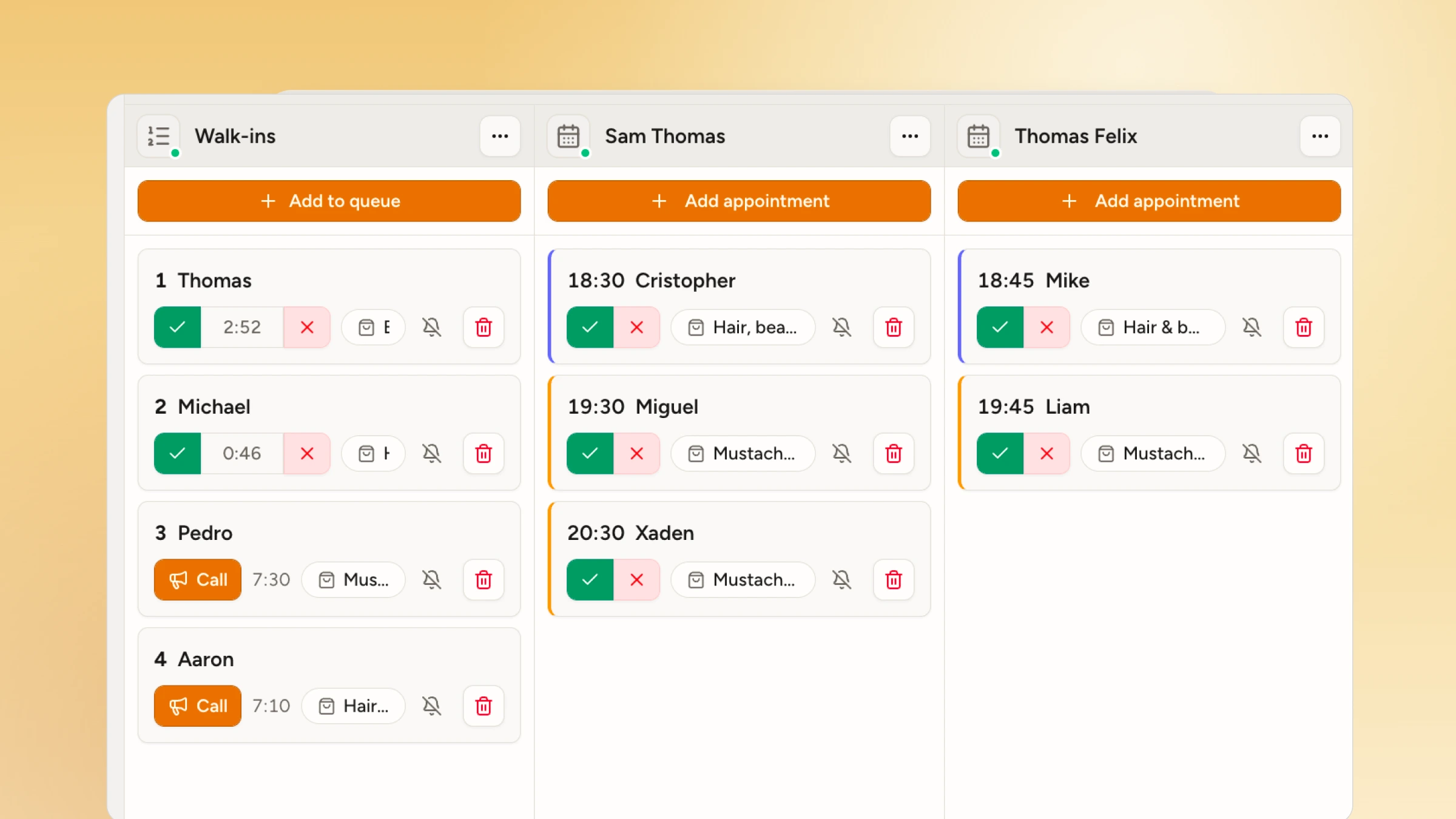
A few other structures that work well:
| Approach | How it works | Best for |
| Dedicated time blocks | Mornings or entire days for walk-ins, afternoons for appointments (or vice versa) | Shops with moderate appointment volume |
| Buffer slots | 1-2 unbooked gaps per hour to absorb walk-in surges | Any multi-barber shop during peak hours |
| Walk-in barber rotation | One barber dedicated to walk-ins on busy shifts; others handle appointments | High-volume Saturdays and Friday afternoons |
| Separate queue lanes | Walk-ins and appointments tracked independently, visible in one dashboard | Shops running both streams simultaneously |
The goal is that walk-ins never feel like a lesser category. A client who walked in should feel as managed and respected as one who booked ahead.
Staffing your barbershop around peak hours
The best time to reduce walk-in chaos is before it starts, and that means matching your staffing to your demand patterns rather than running the same headcount every day.
Barbershop peak hours follow predictable patterns. Square's salon analytics data and broader scheduling research point to consistent trends:
- Weekday lunch rushes between 11am and 1pm
- After-work surges from 4pm to 7pm
- Saturday mornings as the single busiest window of the week for most walk-in shops
If you have part-time barbers or apprentices, Saturday mornings and weekday lunches are where they're most useful. Scheduling them there, rather than on Tuesday afternoons, is one of the higher-leverage moves available to a shop owner.
The other half of staffing well is having data to make decisions from, not guesses. If you're tracking queue volume, you can see exactly which hours are producing walkouts (clients who checked in but never sat down) and adjust staffing accordingly.
What does a digital queue system actually do for a barbershop?
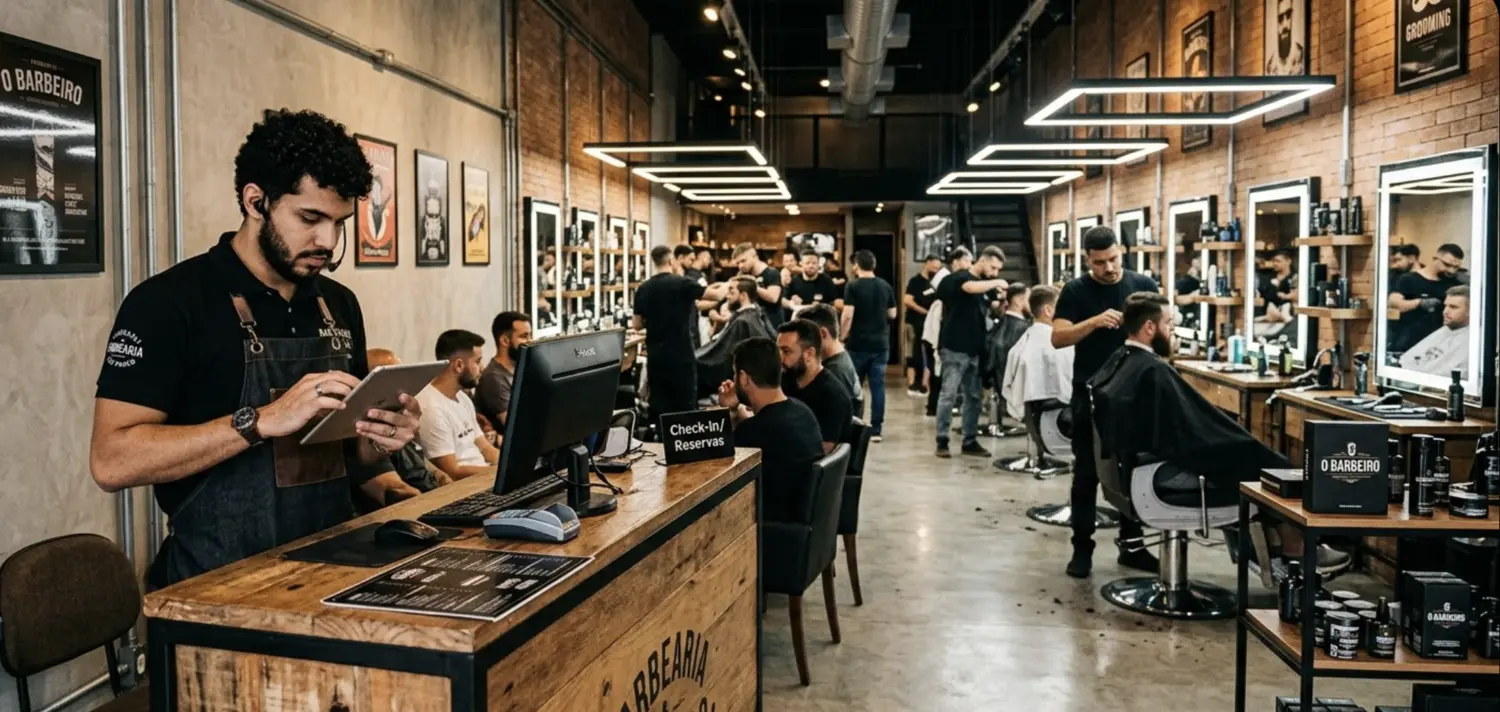
A digital queue system replaces the paper sign-in sheet and verbal name-calling with a flow that clients control from their phone. It adds wait time visibility, automated notifications, and analytics, without requiring any app download.
Here's how it works in a barbershop context: a client walks in (or approaches from outside), scans a QR code at the entrance, picks their service type (haircut, beard trim, hot towel shave), and chooses their preferred barber. They're added to that barber's queue and can see their position in real time.
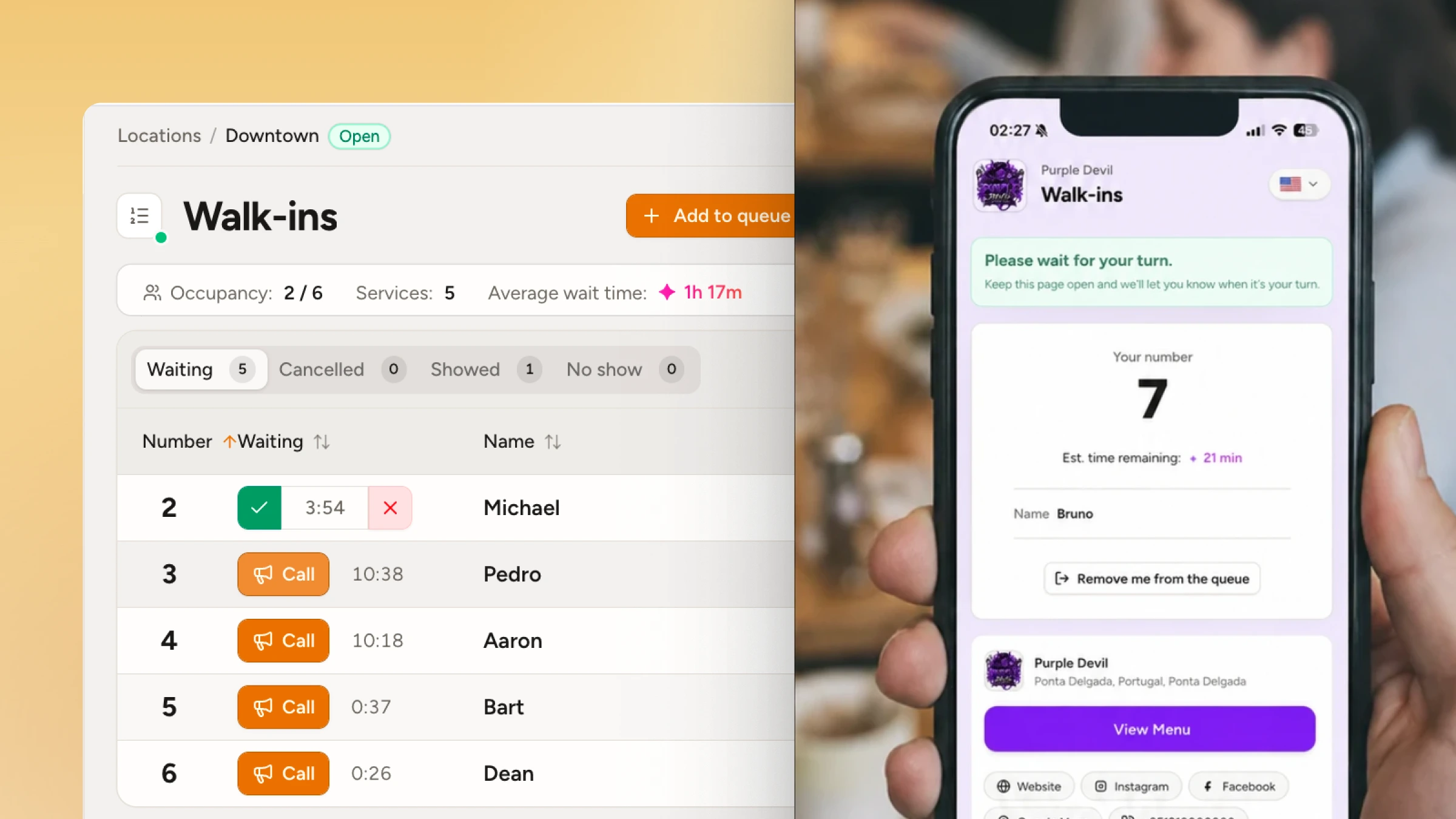
On the barber's side, every waiting client shows up on a single dashboard: name, service, wait time, and status. When the previous cut is done, the barber taps to notify. The client gets an SMS or WhatsApp message telling them it's almost their turn.
The key operational difference from a paper list: clients can leave the shop and come back. They're not tethered to the waiting area. A client who knows they're fourth in their barber's queue can run an errand nearby, sit in their car, or grab a coffee and come back in time. That frees up your waiting area and removes the hovering that makes busy periods feel more chaotic than they are.
QR check-in at your barbershop
Setting up QR check-in doesn't require new hardware and can remove the front-desk bottleneck during peak hours. You need a printed QR code at the entrance (or on your counter or linked from your website or Instagram bio) and a phone or tablet to manage the queue from.
When a client scans the code, they see your shop's branded check-in page. They enter their name, choose a barber and pick a service. The service list should be a match to the items you have in your physical menu. The whole process takes about 30 seconds.
For multi-barber or multi-service shops, separate queues let you route clients correctly, so a 10-minute beard trim doesn't end up blocking a barber whose next three clients are all full haircuts.
How to use queue analytics to run a better barber shop?
Wait analytics show you average wait times, peak traffic windows, and walkout patterns (clients who joined the queue but never sat down). That last metric is the one most barbershops can't see without a digital system, and it's often the clearest signal of where you're losing revenue.
Wait time data reveals patterns. If your data shows a peak of walkouts on a specific time slot or day, that tells you specifically where to add coverage. If one barber's queue consistently runs longer than the others, that tells you something about service duration, demand distribution, or both.
Data also helps you set honest expectations with clients. When you know your average Saturday morning wait is 25 minutes, you can tell walk-ins that confidently, which is infinitely more useful than a vague "it'll be a while."
Managing walk-ins with WaitQ
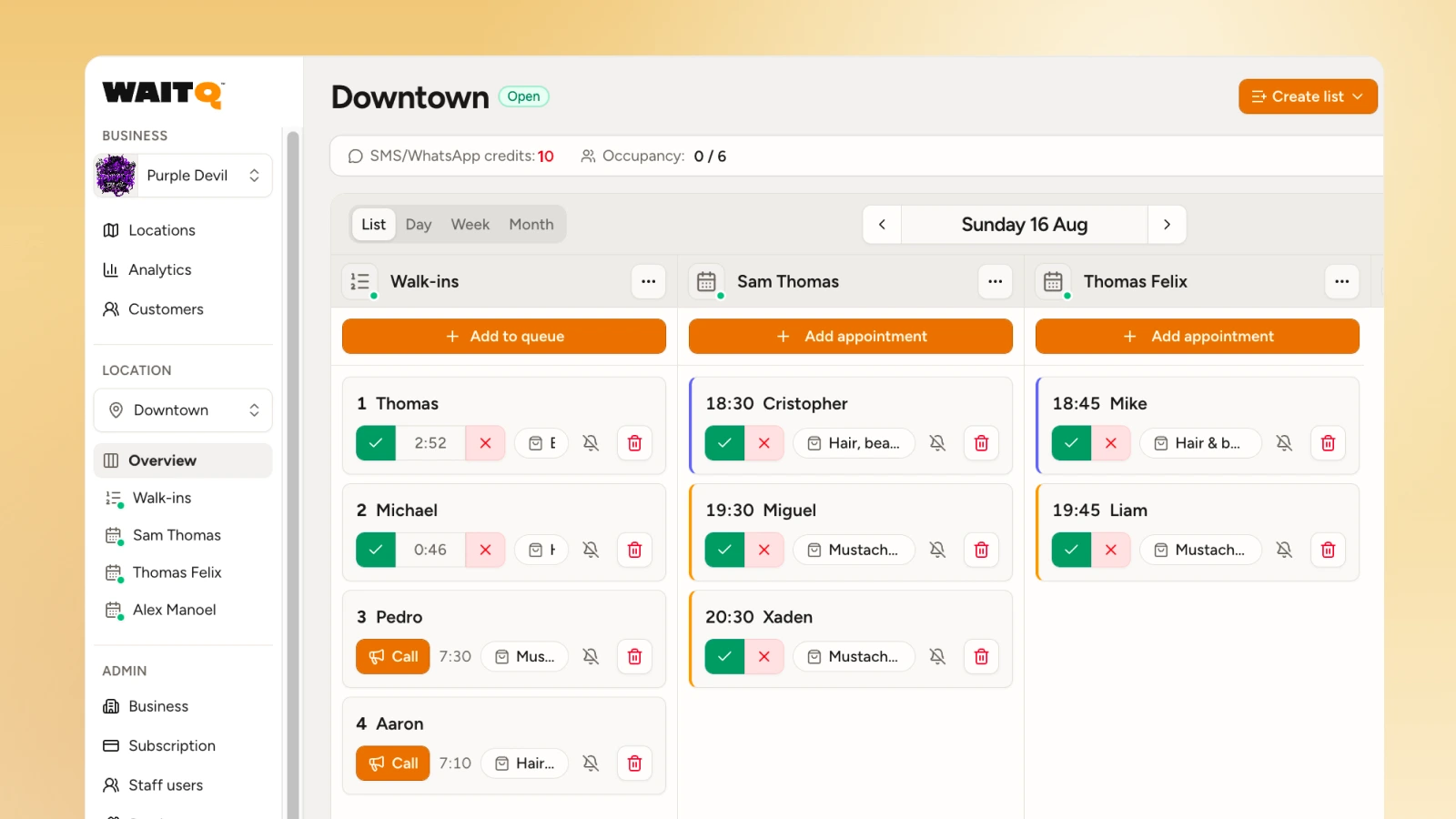
WaitQ supports the per-barber queue model. Clients visit the public check-in page online or scan a QR code at the entrance, choose their service and preferred barber, and simply join that barber's live queue. No accounts or app downloads required.
Your team sees every waiting client from a shared dashboard on any device: phone, tablet, or screen behind the counter. You see the walk-in list alongside each barber's appointment list for easy management of the customer flow at all times.
When a cut's done, one tap sends the next client an SMS or WhatsApp notification. A public display on your TV or mounted tablet shows the current queue so clients know their position without approaching the front desk.
Analytics track wait times, peak hours, and walkout patterns over time, so staffing decisions come from data instead of guessing.
Cut beards but also wait times ✂️
Start a 7-day trial and see how your next busy Saturday feels different.
Turning walk-ins into regulars
Getting a walk-in to stay is the first win. Walk-ins who become regulars are worth significantly more than the revenue from a single visit. A barbershop that captures and retains walk-ins well compounds that value over time.
Here are some few things that move the needle:
- Book the next visit before they leave. The end of the cut, when the client is happy and engaged, is the best moment to ask. "Same time in three weeks?" is a simple prompt that works.
- Encourage them to ask for you by name. If a barber did a good job, clients who know to ask for that specific person return more reliably than those who just show up and take whoever's available. Making barber loyalty explicit is good for retention.
- Ask for a review while they're still in the chair. A client who just got a clean cut and is looking at themselves in the mirror is more likely to leave a review in that moment than they will be an hour later. A direct ask ("If you're happy with it, a Google review really helps us") converts better than a follow-up message.
The takeaway
Walk-in management in barbershops comes down to one thing: making the wait as tolerable as possible. Clients who know their position, their barber's availability, and roughly how long they'll wait stay and come back.
Particularly for higher-volume shops, this means specific queuing software able to handle per-barber queues, QR check-in, and SMS notifications that let clients wait anywhere.
The cost of doing nothing, in walkouts and revenue lost to the shop down the road, is higher than most owners track, which yields the ROI of tools like WaitQ very significant.
