

A barbershop menu does two jobs at once. It tells clients what they can book, and it tells them what your shop is worth. Most menus only do the first job. A basic list of "haircut, $30" leaves money on the table and gives clients nothing to compare their choice against.
What should a barbershop menu include?
A complete barbershop menu should include five categories: core services (cuts, trims, shaves), beard and grooming add-ons, premium or specialty services, bundled packages, and membership plans. Each category should have three to six clearly priced options so clients can scan and decide without asking staff to explain every line.
Shops that only list core cuts miss the add-ons and packages that drive most of the profit margin. A 55% of US barbershops now offer add-on services like beard trims, scalp treatments, or straight razor shaves alongside the base haircut, and shops that price and display those add-ons clearly sell more of them than shops that only mention them verbally at the chair.
Core barbershop services and 2026 pricing
These are the services every barbershop menu should lead with. Pricing below is in USD for the US market, broken into three tiers instead of one wide range, since "$30–$75" tells a client almost nothing about what they're actually paying for. Budget covers a no-frills, high-volume shop; standard is a typical independent barbershop; premium covers experienced barbers, city-centre locations, or an elevated experience. The US national average haircut price sits at $43 as of 2026, which lands inside the standard tier for most regions, up nearly 98% since 2000.
| Service | Budget | Standard | Premium |
| Classic haircut | $20–$30 | $35–$50 | $55–$85 |
| Buzz cut | $15–$22 | $25–$32 | $35–$45 |
| Fade (skin, taper, or drop) | $25–$32 | $35–$50 | $55–$75 |
| Kids' haircut (12 and under) | $15–$20 | $22–$30 | $32–$45 |
| Line-up / shape-up | $8–$12 | $13–$18 | $20–$28 |
| Beard trim | $10–$15 | $18–$25 | $28–$40 |
| Beard trim + hot towel | $18–$25 | $28–$38 | $40–$55 |
| Straight razor shave | $25–$35 | $40–$55 | $60–$85 |
| Haircut + beard combo | $32–$42 | $48–$65 | $70–$95 |
| Scalp treatment | $15–$22 | $25–$32 | $35–$45 |
Print the tier and range you actually charge rather than a generic market average. Clients trust a specific number far more than "starting at."
How barbershop pricing compares in the US, UK, and Australia
Haircut prices vary enough by country that a US range is close to meaningless for a shop in Manchester or Melbourne. Here's how the two most universal services, a standard haircut and a kids' cut, compare across WaitQ's three largest English-language markets.
| Service | US (USD) | UK (GBP) | Australia (AUD) |
| Haircut, independent/local barber | $20–$30 | £12–£20 | $25–$35 |
| Haircut, standard city barbershop | $35–$50 | £18–£28 | $40–$55 |
| Haircut, premium/city-centre barbershop | $55–$85 | £30–£55 | $60–$85 |
| Kids' haircut (12 and under) | $15–$35 | £8–£20 | $15–$40 |
Sources: US figures from WaitQ's barbershop statistics roundup; UK figures from The Barber Board's 2026 UK pricing guide; Australia figures from Findme.hair's 2026 Australian haircut pricing guide.
Beard trims and grooming add-ons scale the same way: expect roughly 40–60% of the local haircut price for a standalone trim, more if it's bundled with a hot towel or shave. A UK "full service" cut, beard, hot towel, and tidy-up at a Turkish barber typically runs £25–£45, which is a useful benchmark if you don't yet have local pricing data of your own.
Everything else in this guide (add-ons, packages, memberships, and the template) is priced in USD for the US market. If you're building a menu for the UK or Australia, use the ratios above to convert: a $40 US add-on maps to roughly £25–£30 in the UK or $45–$55 AUD in Australia, adjusted for your specific city and shop tier.
Beard, shave, and grooming add-ons
Add-ons are the fastest way to raise your average ticket without adding a new appointment slot. They usually take 5–15 extra minutes and carry a higher margin than the base cut, since most use minimal product. Prices below are USD.
- Eyebrow trim or wax ($10–$20)
- Nose and ear waxing ($10–$20)
- Hot towel refresh ($8–$15)
- Beard oil or balm application ($5–$15)
- Neck shave / clean-up ($8–$15)
- Camo color (beard or gray blending) ($20–$40)
- Facial or deep-cleanse treatment ($30–$75)
- Design or hair art (lines, patterns) ($10–$30)
- Kids' first haircut package (cut, certificate, small gift) ($30–$50)
- Head shave ($25–$45)
List add-ons next to the service they pair with, so clients see them without hunting through a separate section. A beard trim listed right under the haircut sells better than one buried at the bottom of the menu.
How much should you charge for barbershop add-ons?
Price add-ons at 30–60% of your base haircut price for anything under 15 minutes, and closer to the price of a standalone service for anything over 20 minutes. A $40 haircut supports a $12–$20 beard trim add-on; a 30-minute facial or scalp treatment deserves a price closer to a full service.
Undercharging add-ons is the most common menu mistake. If a scalp treatment takes as long as a basic cut, it should cost close to what a basic cut costs. Bundling it into a combo price (see the packages below) usually converts better than listing it as a high standalone line item.
Premium and trending services worth adding in 2026
Beyond the basics, these are the services barbershops are adding to differentiate from chains and capture higher-spending clients. Prices are USD; use the ratios in the pricing comparison above to adjust for the UK or Australia.
- Luxury shave experience (straight razor, hot towel, facial massage, scalp treatment bundled): $65–$110
- Signature cut and style package (consultation, cut, product application, style finish): $60–$100
- Hair coloring or gray blending: $50 for a root touch-up up to $150 for a full color service
- Specialty texture cuts (curly, coily, locs, braids): $40 for a simple curly cut up to $200+ for full braiding or loc work
- Creative or design haircuts (patterns, part designs): $35–$70
- Consultation-only sessions for clients planning a major style change: often free or credited toward the service
- Waxing services beyond eyebrows (chest, back): $20–$50
- Skin care add-ons (exfoliation, moisturizing treatments): $15–$35
Not every shop needs all of these. Add the ones that match your barbers' actual skills. A premium service that's inconsistent from chair to chair damages trust faster than not offering it at all.
Package and membership ideas that build repeat visits
Packages bundle multiple services into one price. Memberships charge a flat monthly or recurring fee for a set number of visits or a discount on every visit. Both exist to increase visit frequency and lock in revenue you can forecast.
Package examples (USD):
| Package | Includes | Price |
| The Essential | Haircut + beard trim | $50–$65 |
| The Full Service | Haircut + beard trim + hot towel shave | $70–$95 |
| The Groom's Package | Haircut + shave + facial (pre-event) | $90–$140 |
| Father & Son | Two haircuts, booked together | 10–15% off combined price |
Membership tier examples (USD):
| Tier | Structure | Monthly price |
| Basic | 1 haircut per month | $35–$45 |
| Standard | 1 haircut + 1 beard trim per month | $55–$70 |
| Premium | Unlimited haircuts + one add-on per visit | $85–$120 |
Memberships work best when the value is obvious at a glance. If a client can do the math and see they save money by month two, they sign up. If they have to guess, they don't.
How do you price a barbershop menu without guessing?
Price each service by adding your direct cost (product, time, barber commission) to your target margin, then checking that number against what nearby shops charge for comparable work. Adjust up if your reputation, location, or experience level supports it, and revisit prices every 6–12 months as costs change.
A simple four-step process:
- Calculate your cost per service. Include product cost, barber time at their effective hourly rate, and a share of fixed overhead (rent, utilities, booking software).
- Check the local market. Visit or call three to five comparable shops within your radius and note their pricing for the same service tier.
- Set your position deliberately. Decide if you're pricing to match the market, price below it to win volume, or price above it based on skill, location, or brand.
- Test and adjust. Raise prices in small increments of 5–10% and track whether booking volume holds. The Bureau of Labor Statistics tracks median barber wages nationally, which is a useful sanity check when estimating what your labor cost per service should be.
Avoid pricing purely off competitors. A shop that copies the barbershop down the street inherits that shop's cost structure and mistakes along with its prices.
What makes a barbershop menu easy for clients to choose from?
An easy-to-read menu groups services by category, limits each category to five or six options, and puts the price directly next to the service name. Clients decide faster when they don't have to cross-reference a separate price sheet or ask staff what something costs.
A few layout principles that consistently work:
- Lead with your most popular service in each category instead of sorting alphabetically. Most clients scan top to bottom and stop once something matches what they want.
- Limit each category to three price points. Too many similar options creates hesitation instead of choice.
- Put your highest-margin package in the middle of the list. People tend to compare the items at the start and end of a list against each other, so the middle option gets chosen more often when it's framed as the standard choice.
- Use plain service names. "The Executive" means nothing without a one-line description of what's included.
- Write one short line under each service. Clients read menus in seconds.
Printed, digital, or QR code: which menu format converts best?
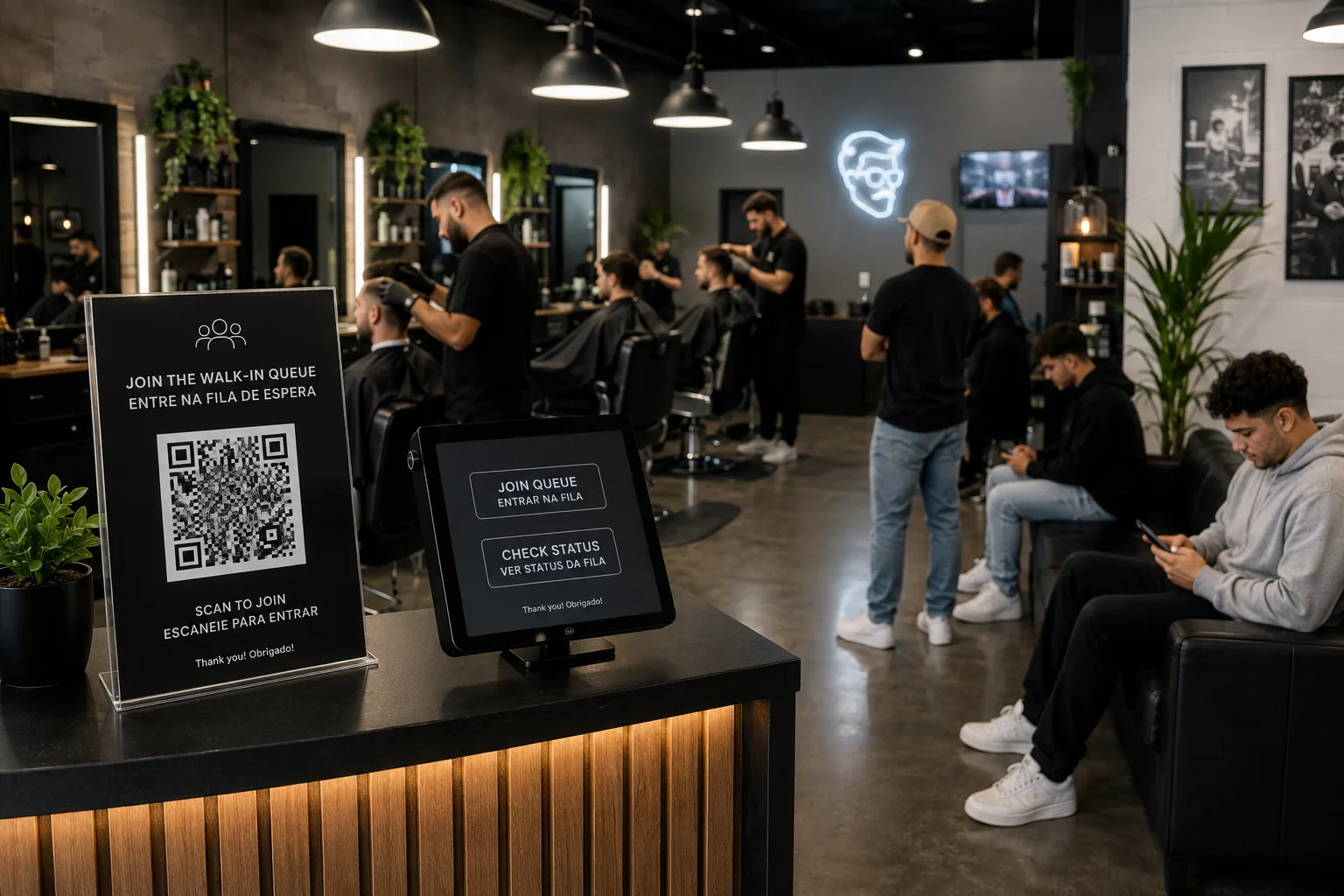
Digital and QR code menus convert better for walk-in-heavy shops because they can be updated instantly and viewed on a client's own phone before they're even in a chair. Printed menus still work well for shops with a strong in-person browsing moment, like a waiting area with limited phone use.
The right format depends on how clients arrive. If most clients book online or check in themselves, a digital menu linked from your booking page or check-in flow means prices and options never go stale. If most clients decide once they're already seated, a printed or laminated menu at the station works fine, as long as it's updated the moment prices change. Many shops run both: a QR code at the door or reception desk for browsing, and a short physical price list at each chair for quick reference.
A menu is only as good as the queue behind it
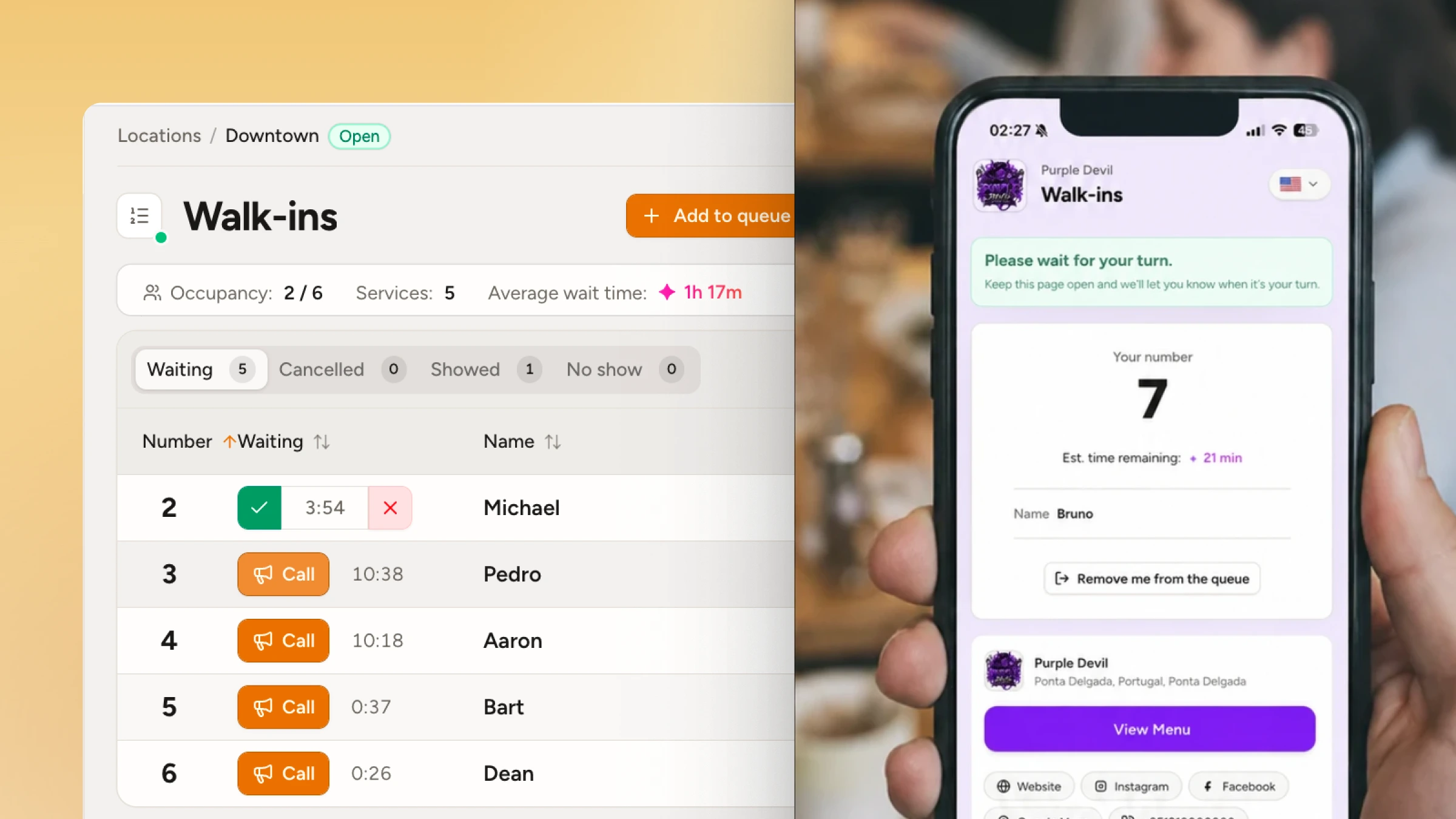
A well-priced, well-organized menu still underperforms if clients can't tell how long they'll wait to redeem it. Barbershops that run on walk-ins lose more revenue to uncertain waits than to menu confusion. Half of clients name waiting as the most frustrating part of a barbershop visit, and shops that give clients a visible position in the queue see meaningfully fewer walk-aways than shops running an unmanaged line.
The connection to your menu is direct. Complex menus with multiple add-ons and packages take longer to explain at check-in, which slows down an already crowded front desk during peak hours. Shops that pair a clear menu with a QR code check-in and automatic wait updates in a waiting room let clients browse services and see their place in line at the same time, instead of choosing while standing at a counter with people behind them.
If your shop still runs walk-ins off a paper sign-in sheet, that friction compounds every time you add a new service to the menu. A digital queue keeps the front desk moving even as the menu grows, and gives clients the same clarity about their wait that a good menu gives them about their options.
Turn each menu item into a bookable or queue-ready service
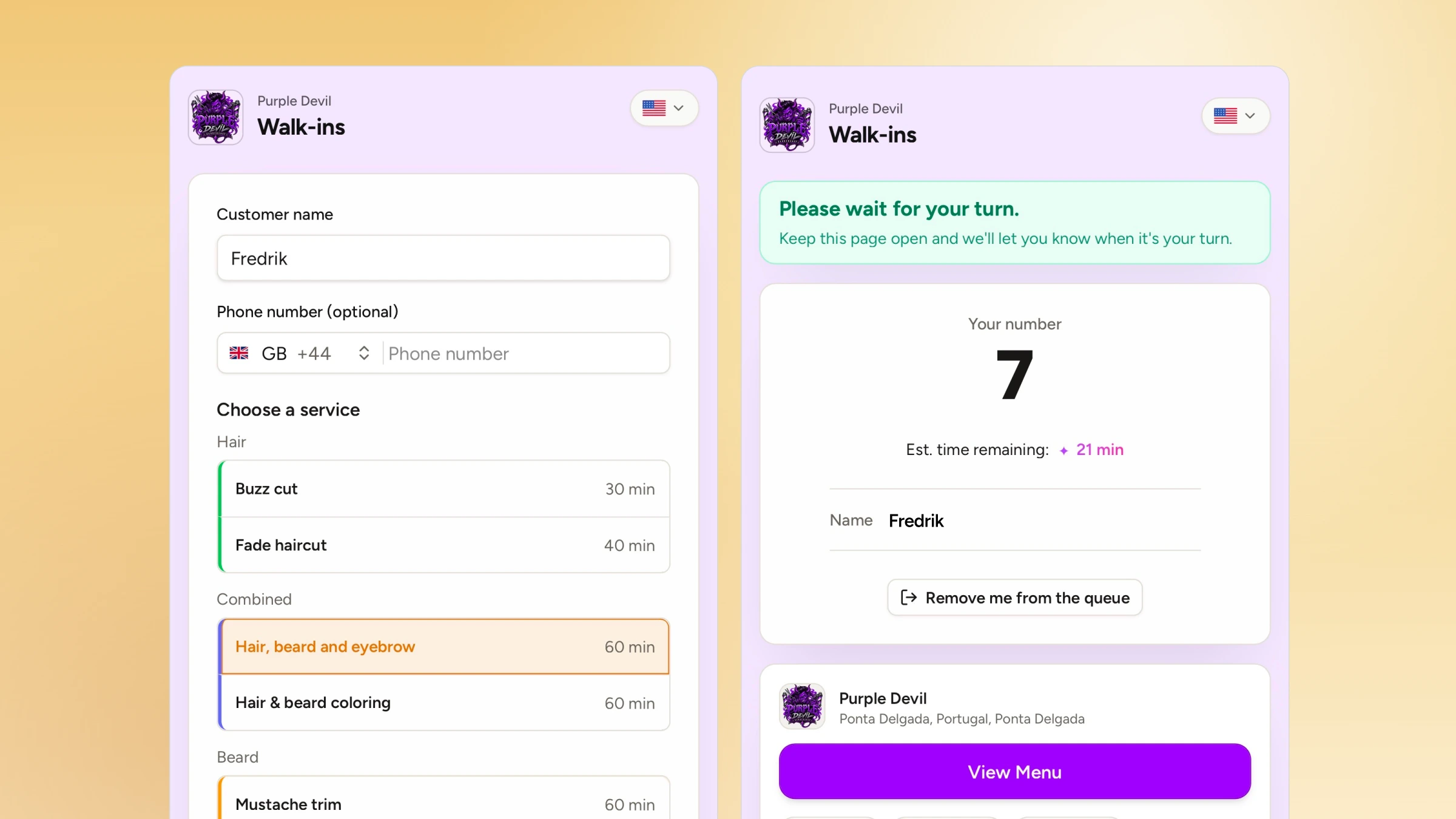
Every line on your menu is really a service definition: a name, a duration, and a price. WaitQ lets you set up each menu item as its own service and decide how clients access it. A 30-minute straight razor shave can require booking a time slot ahead, while a $15 line-up can stay open to clients joining the live queue on arrival. Some shops leave both doors open for the same service, so a client can book ahead if they're planning around it or join the queue if they're just walking by.
Assigning a duration and an access rule to each service keeps that difference visible to clients before they commit, and keeps your schedule based on real numbers instead of guesswork. It also solves a common barbershop edge case: a walk-in client asking for a service you usually book in advance.
Because bookings and the queue run off the same service list in WaitQ, staff can slot that client into whichever flow fits the moment without switching tools or double-booking a chair.
Free barbershop menu template
Copy this structure directly and fill in prices for your market (swap $ for £ or A$ as needed):
CUTS
- Classic haircut: $__
- Buzz cut: $__
- Fade (skin/taper/drop): $__
- Kids' haircut (12 & under): $__
- Line-up / shape-up: $__
BEARD & SHAVE
- Beard trim: $__
- Beard trim + hot towel: $__
- Straight razor shave: $__
- Head shave: $__
ADD-ONS
- Eyebrow trim/wax: $__
- Nose & ear waxing: $__
- Scalp treatment: $__
- Design / hair art: $__
- Camo color / gray blend: $__
PACKAGES
- The Essential (cut + beard trim): $__
- The Full Service (cut + beard + hot towel shave): $__
- The Groom's Package (cut + shave + facial): $__
MEMBERSHIPS
- Basic (1 cut/month): $__/mo
- Standard (1 cut + 1 beard trim/month): $__/mo
- Premium (unlimited cuts + 1 add-on/visit): $__/mo
Keep this on one page or one screen. If it takes scrolling past a second screen to see every option, it's too long for a walk-in to browse before they're called.
