

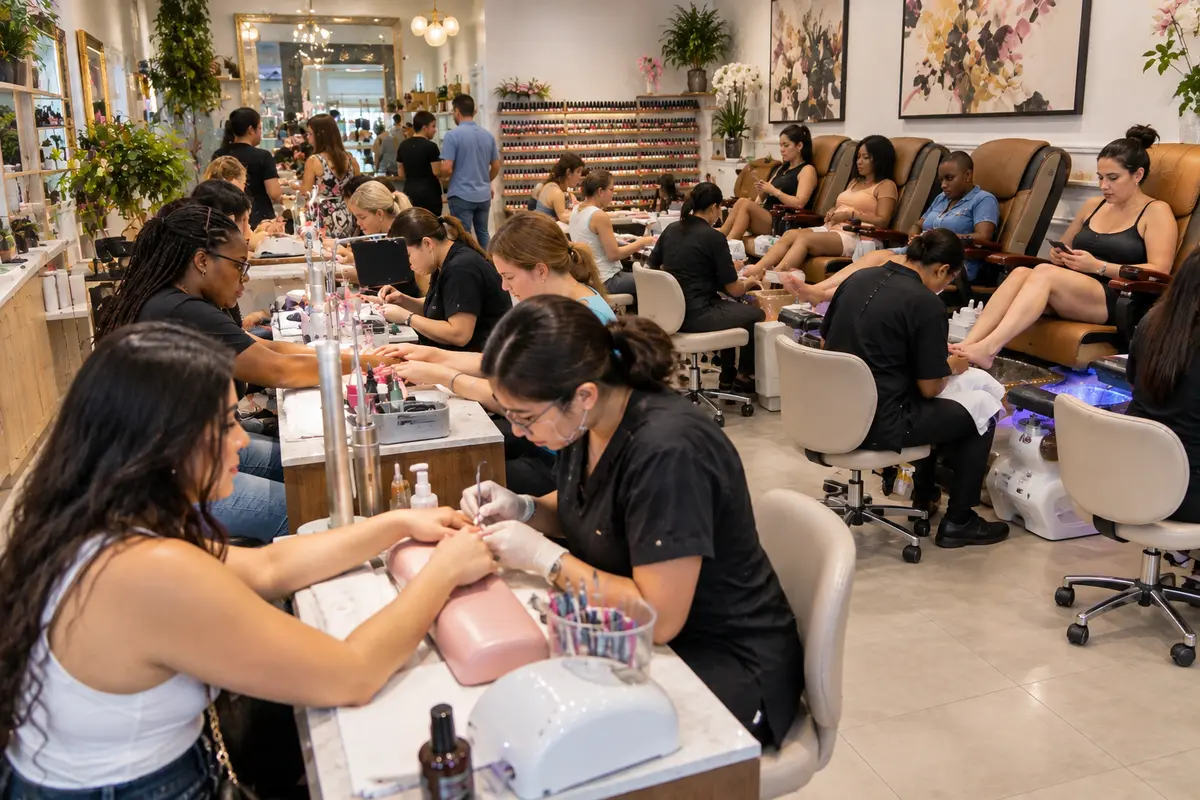
This page compiles the most complete set of publicly available statistics on hair, nail, and beauty salon wait times, booking behavior, cancellations, and market size, drawn from platform-level data, industry benchmark reports, and consumer surveys.
How much do clients dislike waiting at a salon?
- Over 40% of salon and spa guests say waiting for their appointment is the most frustrating part of their visit, according to a Zenoti survey of more than 1,500 beauty and wellness customers
- A separate Zenoti benchmark puts the figure even higher: 52% of salon and spa guests name wait time as the single most frustrating aspect of a visit
- 45% of beauty and wellness clients rank wait times before in-person service as their number one frustration, and more than half say they would hang up if kept on hold for more than three minutes
- Among millennials and Gen Z clients specifically, 50% combined cite waiting around as a source of frustration, while 54% of millennials and 60% of Gen Zers say a quick, easy check-in defines a great salon experience
- A fifth of guests separately flag waiting in line to check out and pay as its own frustration, distinct from the wait for service itself
Takeaway: Salons don't have one wait problem, they have two: the wait for the chair and the wait at checkout. Both show up independently in client surveys, which means a system that only solves the first one is leaving a visible chunk of frustration untouched.
Do clients book ahead or walk in?
- Nail salons in particular run a mix of appointments and walk-ins from the same schedule, with online booking handling advance reservations while a digital queue manages same-day arrivals on the same technician calendar
- The median salon books fewer than 30% of appointments online; top-performing salons book more than 60%, and salons using online booking see 33% more revenue per guest than phone-primary salons
- 80% of salon and spa guests say they want mobile appointment booking, nearly double the roughly 30% of appointments that are actually booked that way at the average salon today
- Between 46% and 50% of salon bookings happen after hours, when the salon is closed and the phone isn't being answered, which only converts to a booking if online scheduling is live
- First-time clients who book online retain roughly twice as well as first-time walk-ins, making the booking channel itself a retention signal, not just a convenience feature
Takeaway: Walk-ins and appointments aren't competing categories at a salon, they're two entry points into the same chair. A stylist's afternoon is built from both, and the businesses seeing the online booking revenue lift are the ones managing both flows in a single, visible schedule instead of a paper book plus a separate sign-in sheet.
How much revenue does booking friction cost?
- 71% of salon regulars say they've decided not to book because it was too hard to reach someone by phone or complete a booking online
- Nail clients are the most impatient booking group in the industry: over 83% of nail salon regulars say they've skipped a booking entirely because they couldn't get through or found the online process too slow
- 55% of clients find limited booking hours frustrating, with more than a third describing it as extremely frustrating rather than a minor annoyance
- Almost half of prospective clients won't consider a salon rated below 4.5 stars, which means a bad wait or check-in experience that turns into a review compounds well past the single lost visit
Takeaway: A missed call and an abandoned online booking cost the same amount: a client who never shows up in the schedule at all. Nail salons feel this hardest, since their clients are the least willing in the entire industry to wait for a callback or a slow booking flow to load.
Cancellation and no-show rates by salon type
- The average salon runs a no-show rate of 15% to 20%, according to the Professional Beauty Association's Salon Industry Report
- That figure swings sharply with the calendar: during a peak summer stretch, no-show rates fell to 3.16% for hair salons, 3.55% for nail salons, and 3.59% for beauty salons, based on over 100,000 missed appointments tracked across booking platforms and reported by Professional Beauty, the UK trade publication for the sector, which still added up to an estimated £2.6 million in lost revenue across those four months
- Outside of peak periods, no-show rates across salons and personal care broadly fall between 5% and 15% in a typical month, shaped heavily by service price, deposit policy, and whether automated reminders are in place
Takeaway: The gap between the 15 to 20% baseline and the sub-4% peak-season figures is the clearest evidence in this whole report that no-shows are a solvable problem, not a fixed cost of running a salon. Deposit requirements and automated reminders are doing real work in the months when clients have the least flexibility to skip an appointment. The opportunity is applying that same discipline in the slower months too.
What does the salon and beauty market look like by region?
The global salon services market, spanning hair, nail, and skin care, was valued at roughly $264.93 billion and is projected to reach $284.53 billion, with hair care alone accounting for over three-quarters of that spend. Europe holds the largest regional share at nearly 32%.
Regional breakdown and market differences
Market size, growth rate, and booking culture vary by region. The table below compares the markets where WaitQ operates.
| Region / market | Market size | Growth trend | Businesses | Booking mix | Notes |
| United States | $63.4bn (hair salons) | 2.1% CAGR (2021–2026) | ~1 million hair salons; 130,000+ nail salons | Mixed, appointment-led | Nail care alone generates over $8bn in the US |
| United Kingdom | £5.7bn | 3.1% CAGR (2020–2025) | 51,821 businesses | Appointment-led | Combined hairdressing and beauty treatment category |
| Australia | A$12.4bn | 5.9% CAGR (2020–2025) | 40,346 businesses | Appointment-led | Fastest-growing of the three English-speaking markets |
| Latin America | $8.64bn (hair care) | 6.3% CAGR | Fragmented, Brazil dominant | Strong walk-in culture | Brazil is the region's largest and fastest-growing hair care market |
A few patterns worth noting:
- Australia is growing faster than either the US or UK on a percentage basis, even though its market is smallest in absolute terms. That points to a market still catching up on adoption of digital booking and queue tools rather than one nearing saturation.
- The UK's beauty treatment category is measured jointly with hairdressing, which understates how much of that £5.7bn is nail and beauty-specific spend compared to the US, where nail salons are tracked as their own segment worth over $8bn on their own.
- Latin America's hair care market is growing faster than any market in this table, and it's also the one with the strongest walk-in culture, which makes queue visibility a bigger opportunity than appointment reminders alone.
Takeaway: Hair care dominates salon revenue everywhere, but the nail segment is large enough in the US alone to be its own multi-billion-dollar category, and it's the segment showing the least patience for slow booking or unclear waits anywhere in the data.
How WaitQ works for hair, nail, and beauty salons
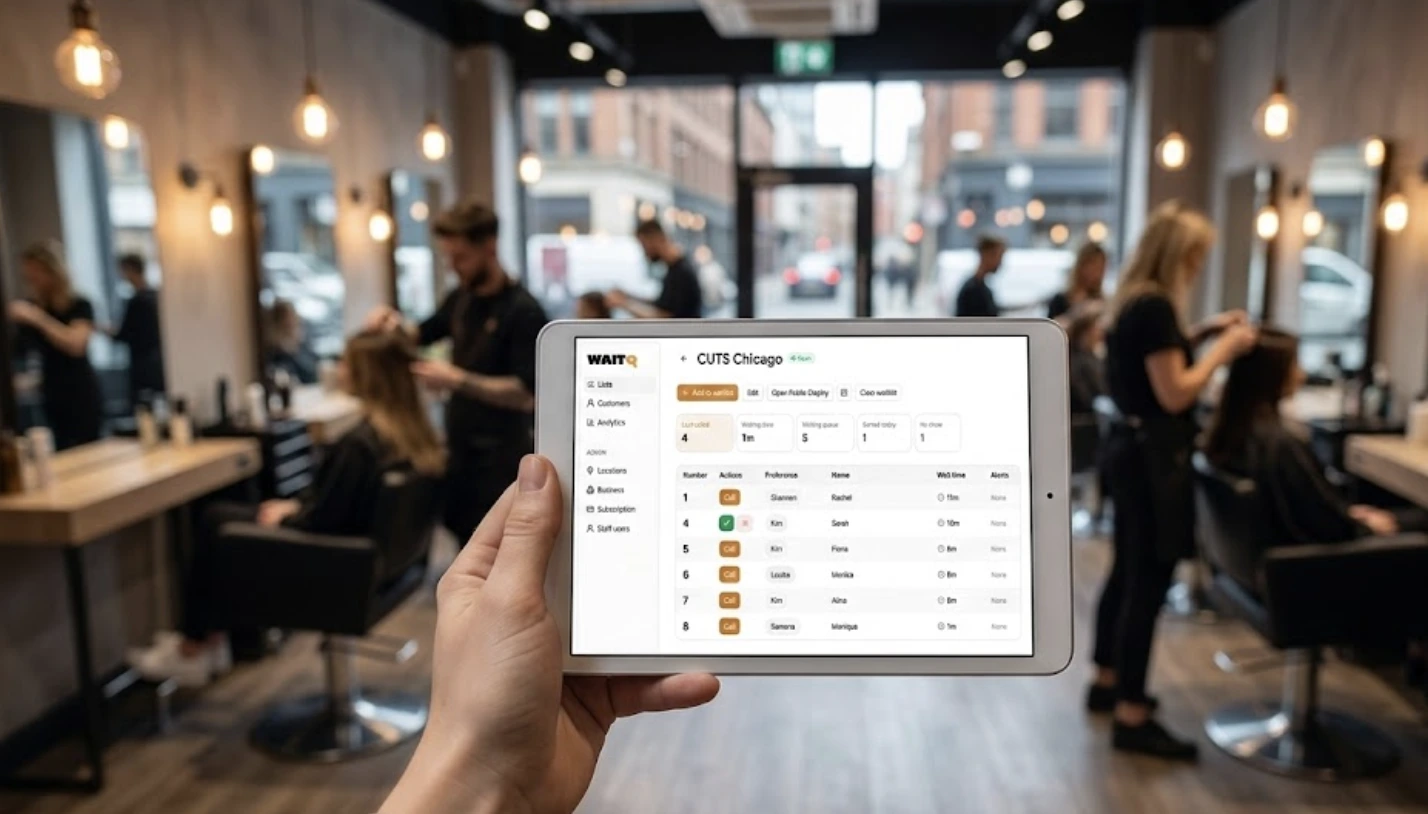
WaitQ is a queue management and appointment system for hair, nail and beauty salons.
How it works
- Clients scan a QR code or use your business check-in page
- They join a queue and see their position on a virtual waiting room instead of hovering at reception. They can also book a time ahead for a specific stylist or technician.
- Clients get notified when their chair is ready, via SMS or WhatsApp
- You get valuable wait insights that improve your operations over time
Each stylist or technician can run their own queue, so a client waiting on a specific colorist doesn't get pulled into someone else's line. Appointments and walk-ins live on the same schedule, so nothing gets double-booked and nobody at the front desk has to check two systems to know what's coming next.
Wait analytics track average wait by day and by stylist, which turns "Saturdays are busy" into an actual staffing decision.
Test the full setup with a 7-day free trial, including notifications and appointments, and see the difference in your customer flow.
Wrap-up
The data lines up across every source: salon clients will wait, but the tolerance is thin, and nail clients in particular have almost none of it left. The 40 to 52% frustration range around waiting, the 71% of regulars who've abandoned a booking over friction, the 16.96% hair salon cancellation rate against a 21.52% high for lash and brow, these numbers all point to the same operational gap: clients who can't see where they stand, whether that's in a queue or in a booking flow, don't stay.
Closing that gap starts with visibility on both sides of the chair, managing walk-in wait times as carefully as the appointment book itself. For salons weighing their options, comparing waitlist and booking tools built for the beauty industry is a good next step, and getting a queue and appointment system running takes about five minutes with plans starting from $27 a month.
