

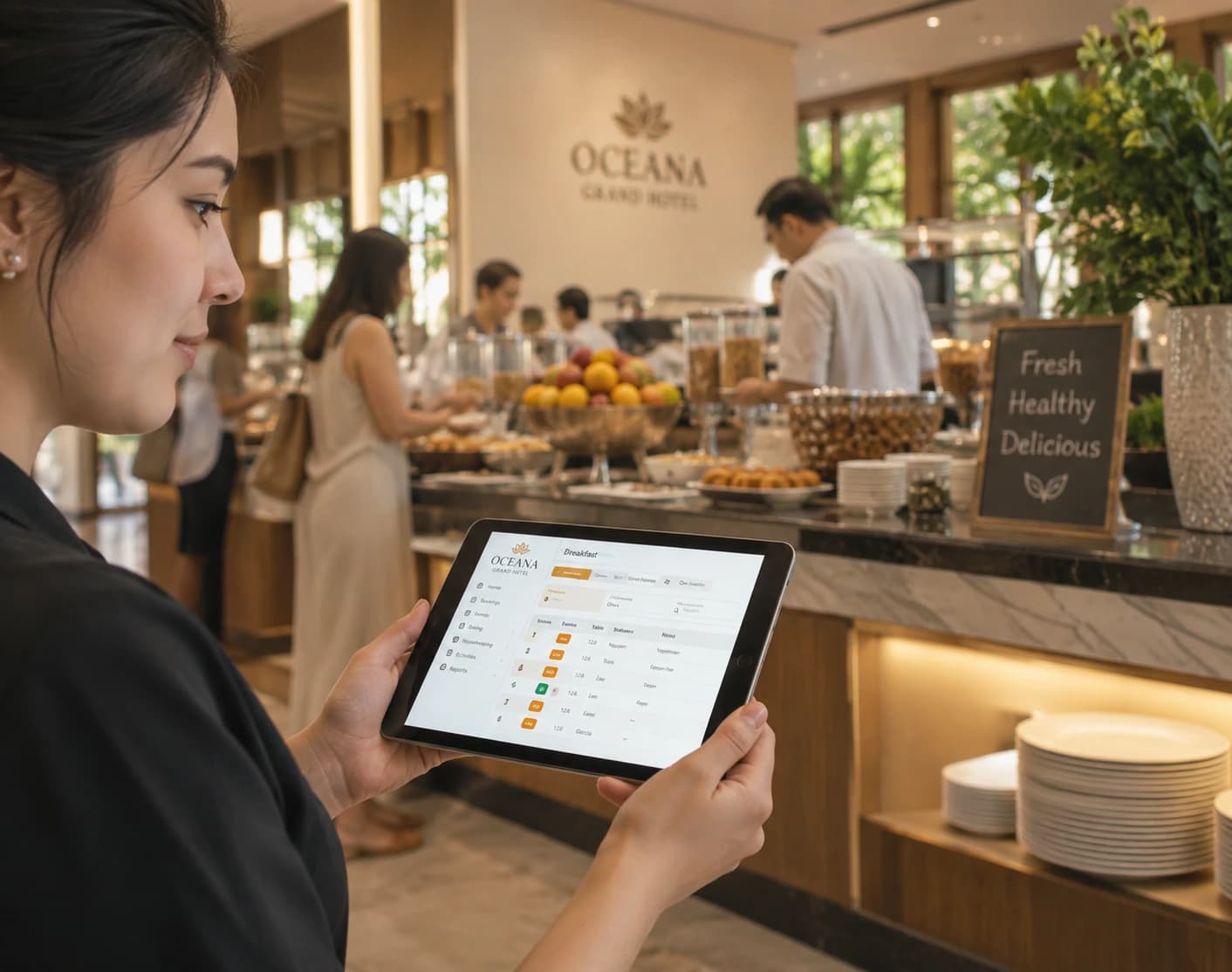
Hotel guest flow is the movement of guests through every point in a stay where they wait for something: arrival, room readiness, breakfast, dining, spa treatments, activities and check-out.
The 50+ data insights and statistics below follow that order, from the first minute at the front desk to the final bill, ending each section with key takeaways for day-to-day operations.
How long do hotel guests wait to check in?
A traditional front-desk check-in takes 5 to 8 minutes per guest, and American guests' satisfaction drops sharply after five minutes of waiting. Most arrivals land in the same afternoon window, so the front desk often hits that limit at its busiest moment.
- A standard check-in covering ID, payment, room assignment and key cards takes 5 to 8 minutes per guest. For a 150-room hotel at 80% occupancy with arrivals concentrated in a two-hour window, that adds up to 15 hours (!) of front desk time compressed into an afternoon. With online pre-registration, the in-person handoff drops to under 90 seconds.
- In a Mews survey of 2,000 US travelers, 82% of hotel loyalty members report problems with current hotel systems, including lengthy check-in.
- Hotel Tech Report's 2026 guest survey found 43% of luxury guests expect not to wait in lines at all.
- J.D. Power and Cornell's Center for Hospitality Research's two years of data from nearly 200,000 hotel guests across eight countries found that American guests' satisfaction index drops by 50 points after a five-minute wait at check-in.
- Most hotels set check-in at 3 PM, with a range from 2 PM to 4 PM. A fixed time concentrates arrivals, so a large share of the day's guests reach the desk within the same hour or two.
Takeaway: At 5 to 8 minutes per transaction, one agent clears roughly 8 to 12 arrivals an hour, so the second guest in line is already at the five-minute threshold. Pre-registration cuts the desk interaction to under 90 seconds, which multiplies desk capacity three to five times during the 2 PM to 5 PM peak. Tracking arrivals per hour in that window gives a reliable basis for front desk rostering.
How does check-in patience vary by guest nationality?
Guest tolerance for check-in waits depends heavily on where guests come from. On average, American guests have the shortest fuse at just five minutes, while Japanese guests tolerate up to half an hour before satisfaction drops.
The Cornell and J.D. Power research measured how long guests from each country waited before their satisfaction index fell by 50 points:
| Guest origin | Time before satisfaction drops | What it means at the front desk |
| United States 🇺🇸 | 5 minutes | Even a short queue during the arrival peak is visible in satisfaction scores |
| Canada 🇨🇦 | 7 minutes | Little room to absorb group or tour arrivals |
| France 🇫🇷, Germany 🇩🇪, Italy 🇮🇹, Spain 🇪🇸 | 15 minutes | More tolerance, though peak-hour queues can still pass the limit |
| United Kingdom 🇬🇧 | 17 minutes | Patience holds for a typical queue but not for a backlog |
| Japan 🇯🇵 | 30 minutes | Highest tolerance, with high expectations for how the wait is handled |
Takeaway: For hotels with an international guest mix, set the bar by the least patient guest tolerance. Days with a high share of US or Canadian guests, or a North American tour group, call for a 5 to 7 minute wait target and extra desk cover. A mostly European arrival list allows more wiggle room: closer to 15 minutes of tolerance.
What happens when guests arrive before their room is ready?
Early arrivals create a second, less visible queue: guests who have checked in but can't access their room yet.
- Hotels typically work with a three to five hour turnaround between published check-out and check-in times, which leaves early arrivals waiting with their luggage or in the lobby.
- HotelData's labor analysis of about 5,000 US hotels found room attendants at select-service hotels spent 22.82 minutes per occupied room.
- Housekeeping is the most frequently cited staffing shortage in US hotels, named by 38% of properties, which directly slows room turnover on busy changeover days.
- Lobbies are where those guests end up waiting, yet only 43% of guests perceive hotel common areas as inviting.
Takeaway: Early arrivals are predictable when hotels collect estimated arrival times before the stay. Prioritizing housekeeping by arrival time, and actively notifying guests when their room is ready, removes the repeat desk visits from guests checking back on their room and improves overall experience.
Do hotel guests want to skip the front desk?
A large share of hotel guests now prefer handling routine steps on their own phone. Nearly half prefer smartphone check-out, and most travelers want to manage their stay from their own device. Research below shows hotel executives need to make improving or replacing the front desk experience a top technology priority.
- In Hotel Tech Report's global guest survey, 45% of guests prefer to check out using their smartphone, as opposed to the 42% who still prefer the front desk.
- An Oracle Hospitality and Skift study found that 73% of travelers want to use their mobile device to manage their hotel experience, including checking in and out, paying and ordering food.
- 70% of American travelers would likely check in through an app or kiosk instead of the front desk, rising to 82% among Gen Z.
- 54% of hotel executives said their top technology priority was improving or eliminating the front desk experience.
- Guests who use their hotel's mobile app report an average satisfaction score of 699, compared with 631 for those who don't, according to J.D. Power.
- That said, human contact still matters for anything complicated: 70% of guests find chatbots helpful for simple questions but still prefer a person for complex requests.
Takeaway: With guests split 45% to 42% between phone and front desk preference, hotels need both channels running. App users score 68 points higher on satisfaction, yet many guests won't download an app for a short stay, so browser-based options are preferable. The front desk team can then focus on more complex requests.
How much does breakfast and hotel dining matter to guests?
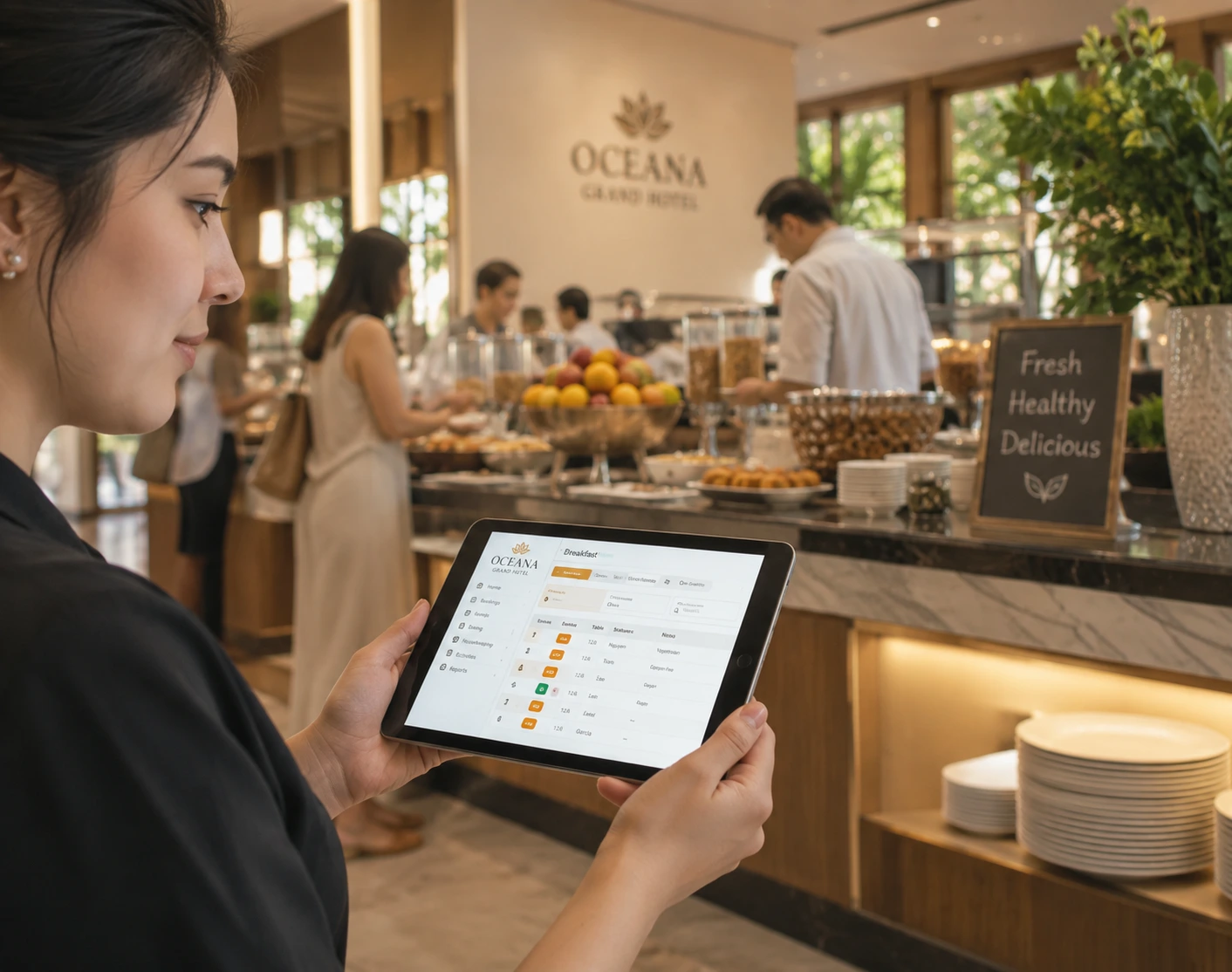
Breakfast is the meal most hotel diners eat on property, and nearly half of midscale guests treat it as a requirement. More than half of online hotel reviews mention it, and food and beverage is historically the second-largest revenue source in the hotel industry.
- 78% of guests who use hotel food and beverage eat breakfast at the hotel. 47% of upper-midscale and midscale guests rate free breakfast as a must-have.
- Research from the University of Aveiro in Portugal found that more than half of online hotel reviews reference breakfast, and two-thirds of those mentions are positive.
- Food and beverage is historically the second-largest source of hotel revenue, and F&B revenue per occupied room grew 3.8% in CBRE's latest analysis.
- Food and beverage satisfaction rose 14 points in J.D. Power's latest North America hotel guest study, one of the largest gains of any part of the stay. Hotel restaurants open to outside diners face the same dynamics as any restaurant at peak hours, including how long diners will wait for a table and when they walk away.
Takeaway: 78% of hotel diners eat breakfast on property, and it appears in over half of reviews, so it deserves the same capacity planning as the front desk. Counting covers in 15-minute intervals shows exactly when the room fills, which tells the team when to open overflow seating or start a queue at the door.
How do guests book spa treatments, tours and other activities during a hotel stay?
Hotel guests book spa treatments and activities at short notice, many with less than 24 hours' notice, putting added pressure on staff and front desk.
- Hotel spas generate 3.4% of total hotel revenue on average, rising to 4.2% at luxury properties, according to CBRE's analysis of ~300 US hotels that operate a spa.
- Hotel spas lag behind on digital booking though: 55% of day spas offer online booking, compared with only 38% of resort and hotel spas, according to the International Spa Association.
- At resort and hotel spas, one in five appointments is booked within 24 hours, which puts much of the demand inside the stay itself.
- 33% of travelers are willing to pay more to use spa, wellness or fitness services, and 87% say they would likely book a hotel that let them pay only for the amenities they use.
- In a survey of 500 hotel guests in the UK, Germany and France, 77% wanted to request room service or other facilities through an app, and 94% wanted their hotel to suggest an itinerary based on their interests.
- Guests who check in at a self-service kiosk are three times more likely to buy an upsell such as spa access or a breakfast add-on, according to Mews data from US hotels.
Takeaway: Most hotel spa and activity demand is decided during the stay, and fewer than 40% of hotel spas let guests book online. Every same-day request then lands on the spa reception, the concierge or the phone. Sharing a booking link with live availability in the pre-arrival or check-in message would reach guests at the moment they are most likely to add services.
How does hotel staffing affect guest flow?
Staffing shortages turn every queue in the hotel into a longer one. More than half of US hotels report being understaffed, front desk roles are among the hardest to fill, and guests notice: slow service caused by short staffing is one of the main reasons travelers don't rebook.
- According to the American Hotel & Lodging Association's most recent survey, more than half of hoteliers report their properties are somewhat or severely understaffed.
- Front desk roles are the second most-cited shortage, at 26% of hotels, behind housekeeping.
- 34% of travelers say a staff shortage and the slow service that follows would be their number one reason not to rebook a hotel.
- On average, 12% of guests experience a problem during their stay, such as a check-in dispute or a housekeeping issue, and their satisfaction drops 217 points on J.D. Power's 1,000-point scale.
Takeaway: With 34% of travelers ready to skip a rebooking over slow service, understaffing has a direct cost in repeat business. Measuring waits at each touchpoint shows where limited staff hours have the most effect and letting guests join a queue or book a slot themselves gives a stretched team that time back.
What do guests expect at check-out?
Check-out is the last impression before the review gets written. Nearly half of guests would rather settle up on their phone, and online reviews are the main factor for almost half of travelers when they choose their next hotel.
- Almost half of guests prefer to check out using their smartphone, according to Hotel Tech Report's 2026 guest survey.
- 48% of guests consider online reviews the main factor in choosing a hotel.
- Check-in and check-out together form one of the seven core dimensions J.D. Power uses to measure overall hotel guest satisfaction.
Takeaway: Morning check-out overlaps with the breakfast peak and early departures for flights. Sending the final bill to guests the evening before, and offering phone check-out, keeps the desk free for billing questions. Departure times collected during the stay help the team staff the desk for the busiest hour.
How does WaitQ manage hotel guest flow?
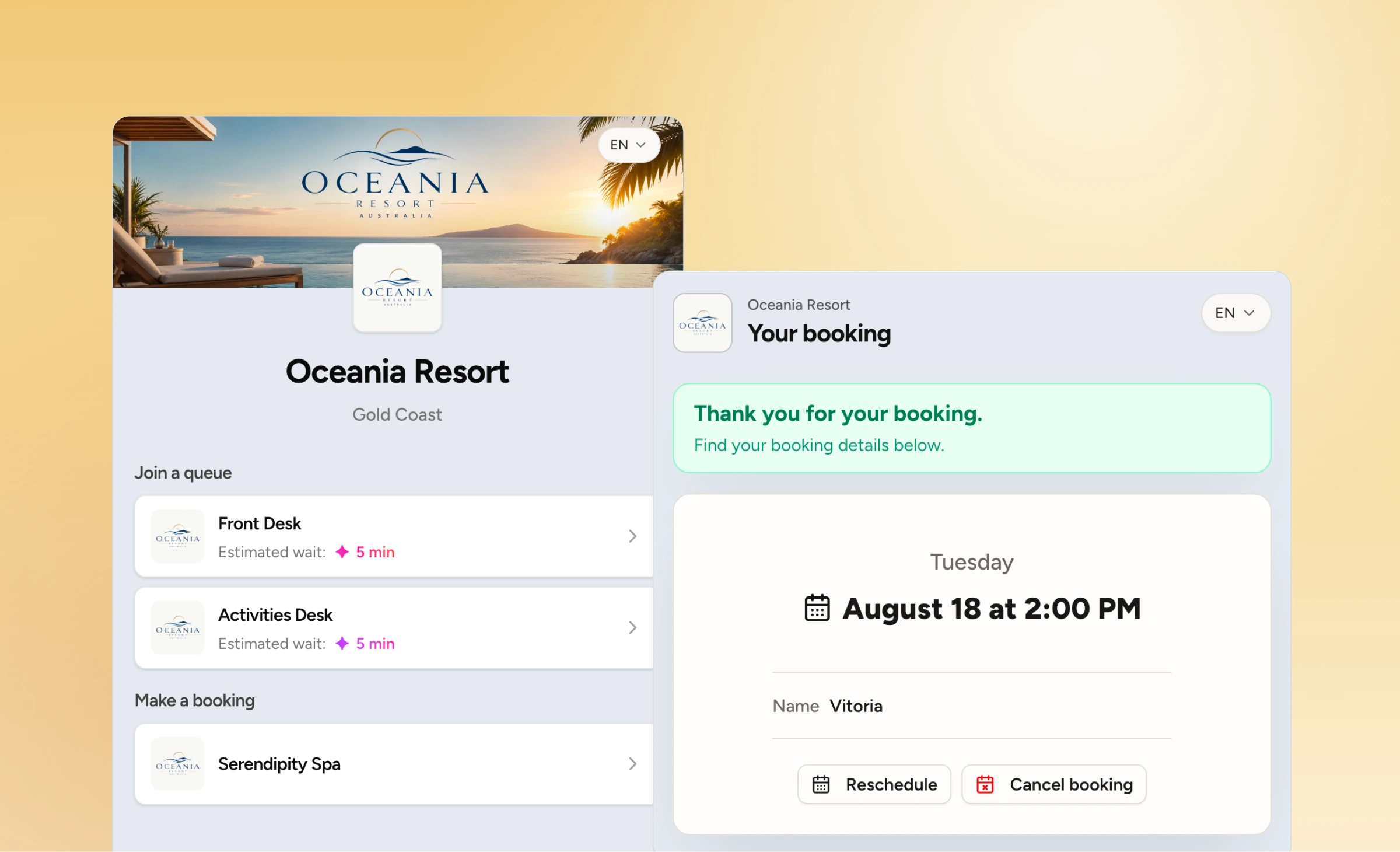
WaitQ is a queue and booking management system that handles every guest touchpoint in a hotel from one dashboard, including the front desk, breakfast room, restaurant, spa and activities.
At the front desk, arriving guests join the queue from a QR code at the entrance and wait wherever they like. Guests who arrive before their room is ready can go to the pool or the bar and get a message when housekeeping is done.
At the breakfast buffet, hotels can handle peak hours in one of two ways:
- A digital queue covers walk-up demand: guests can join the queue even before leaving the room and get notified when their table is ready.
- A digital guest list for hotels that track breakfast by room. Staff tap each room as its guests arrive, with no paper sheets or room numbers to look up.
Spa treatments, tours and activities run through appointments on a branded check-in page, which lets guests book short-notice slots from their phone without calling or queuing at the concierge desk. Wedding, group and conference guests can be checked in by name from a guest list.
Every department shares one view, and analytics show when demand peaks at each touchpoint, which gives real, valuable data to help with staffing and improving operations on the long term.
