

On this page
- What is the best restaurant reservation system?
- Quick picks by restaurant type
- How did we compare these restaurant reservation systems?
- OpenTable
- WaitQ
- Resy
- Tock
- SevenRooms
- Yelp Guest Manager
- Eat App
- Toast Tables
- TableCheck
- ResDiary
- TheFork Manager
- Restaurant reservation software compared side by side
- What does a restaurant reservation system cost?
- How do restaurant reservation systems handle walk-ins?
- Marketplace vs direct bookings: who owns the guest data?
- Which restaurant reservation system should you choose?
- Conclusion
What is the best restaurant reservation system?
If you need diners from a marketplace, OpenTable and Resy are the realistic options. Tock is the one built for prepaid tasting menus. For a restaurant that takes bookings and walk-ins on the same night, WaitQ fits because guests join the waitlist from their own phone on every plan.
Most comparisons of this category lead with the starting price, which is the least useful number on the invoice. OpenTable Core is $299 a month on paper and $699 once 400 marketplace diners come through it. Yelp's cheaper plan stops at 500 covers. Eat App keeps the online waitlist for its Pro plan. We priced all 11 systems at 1,000 covers a month and checked what each one does when a party of two walks in without a booking.
- #1OpenTableBest for marketplace bookingsReview ›Starting price$149/monthCover fees$1 to $1.50 per network cover
- #2
 WaitQBest for bookings and walk-ins on one floor planReview ›Starting price$27/monthCover feesNone
- #3ResyBest for marketplace bookings at a flat priceReview ›Starting price$289/monthCover feesNone
- #4TockBest for prepaid menus and experiencesReview ›Starting price$289/monthCover feesNone, 2% to 3% on prepayments
- #5SevenRoomsBest for groups that want a guest CRMReview ›Starting priceQuote onlyCover feesNone, setup fee
- #6Yelp Guest ManagerBest for restaurants with Yelp trafficReview ›Starting price$129/monthCover feesNone
- #7Eat AppBest for booking-led restaurants starting freeReview ›Starting priceFree, paid from $69/monthCover feesNone
- #8Toast TablesBest for toast POS restaurantsReview ›Starting price$199/month for PlusCover feesNone
- #9TableCheckBest for hotel restaurants and groups in Asia-PacificReview ›Starting priceQuote onlyCover feesNone on direct bookings
- #10ResDiaryBest for UK and Australian independentsReview ›Starting price£109/month + VATCover feesNone
- #11TheFork ManagerBest for european restaurants on TheForkReview ›Starting priceQuote onlyCover feesCommission on TheFork bookings
WaitQ is our product. We held it to the same template as everyone else, cons included, and each review says who the tool suits and who should look elsewhere.
Quick picks by restaurant type
- Bookings and walk-ins every night: WaitQ
- Diners from a large marketplace: OpenTable or Resy
- Prepaid tasting menus, events and experiences: Tock
- Restaurant groups that want a guest CRM: SevenRooms
- Restaurants already getting diners from Yelp: Yelp Guest Manager
- Restaurants on Toast POS: Toast Tables
How did we compare these restaurant reservation systems?
A restaurant reservation system is software that takes table bookings online, shows staff a live view of tables and guests, and sends confirmations and reminders. Nearly all of them bolt on a waitlist for walk-ins, and the waitlist is where they differ most.
We read every vendor's live pricing page, feature pages and help docs in November 2026 and used list prices, with annual rates where the vendor shows them. Where a vendor publishes no prices, we say so instead of quoting third-party estimates.
- No per-cover feesYou pay the same however many diners book, with no charge per cover.
- Guests join the waitlist themselvesWalk-ins join from a QR code, link or Google, without the host typing their details.
- Bookings and walk-ins on one floor planThe host sees booked and waiting guests against the same tables.
- Deposits or card holdsDeposits, prepayments or card holds to protect against no-shows.
- Published pricingPrices are on the vendor's website without a sales call.
- Diner marketplaceA consumer app or site where new diners can find and book you.
- Flat price at any volumeNo cover or booking cap that pushes you onto a pricier plan.
Details come from each vendor's public pricing page, feature pages and help center, checked in November 2026.
OpenTable
Best for marketplace bookings
VerdictOpenTable is built for restaurants that want bookings from a large diner marketplace and accept cover fees in return.
- Starting price
- $149/month
- Cover fees
- $1 to $1.50 per network cover
- Walk-in waitlist
- Core and Pro
Your restaurant gets listed in the OpenTable diner app and partner network, with bookings, floor plans and a waitlist on the Core and Pro plans. Basic is US-only and has no floor plan or waitlist.
The cover fee only pays off for diners who would never have found you otherwise. If most OpenTable bookings come from people who already know the restaurant, you're paying $1 each to seat your own regulars.
Pros & Cons
Highlights
- Diners can find and book you inside OpenTable's app and partner sites
- Deposits and credit card holds on every plan
- In-house and online waitlist on Core and Pro
- No cover fees on phone bookings or walk-ins
What to watch out for
- Per-cover fees on every plan for diners from the OpenTable network
- Website bookings cost extra on Basic
- Table management and the waitlist start on Core at $299/month
- Prepaid experiences and ticketing carry a 2% fee on Core and Pro
Pricing
OpenTable Basic costs $149/month plus $1.50 per network cover after a 30-day free period, with website bookings at $0.25 per cover or $49/month. Core costs $299/month and Pro $499/month, each plus $1 per network cover, with website bookings included.
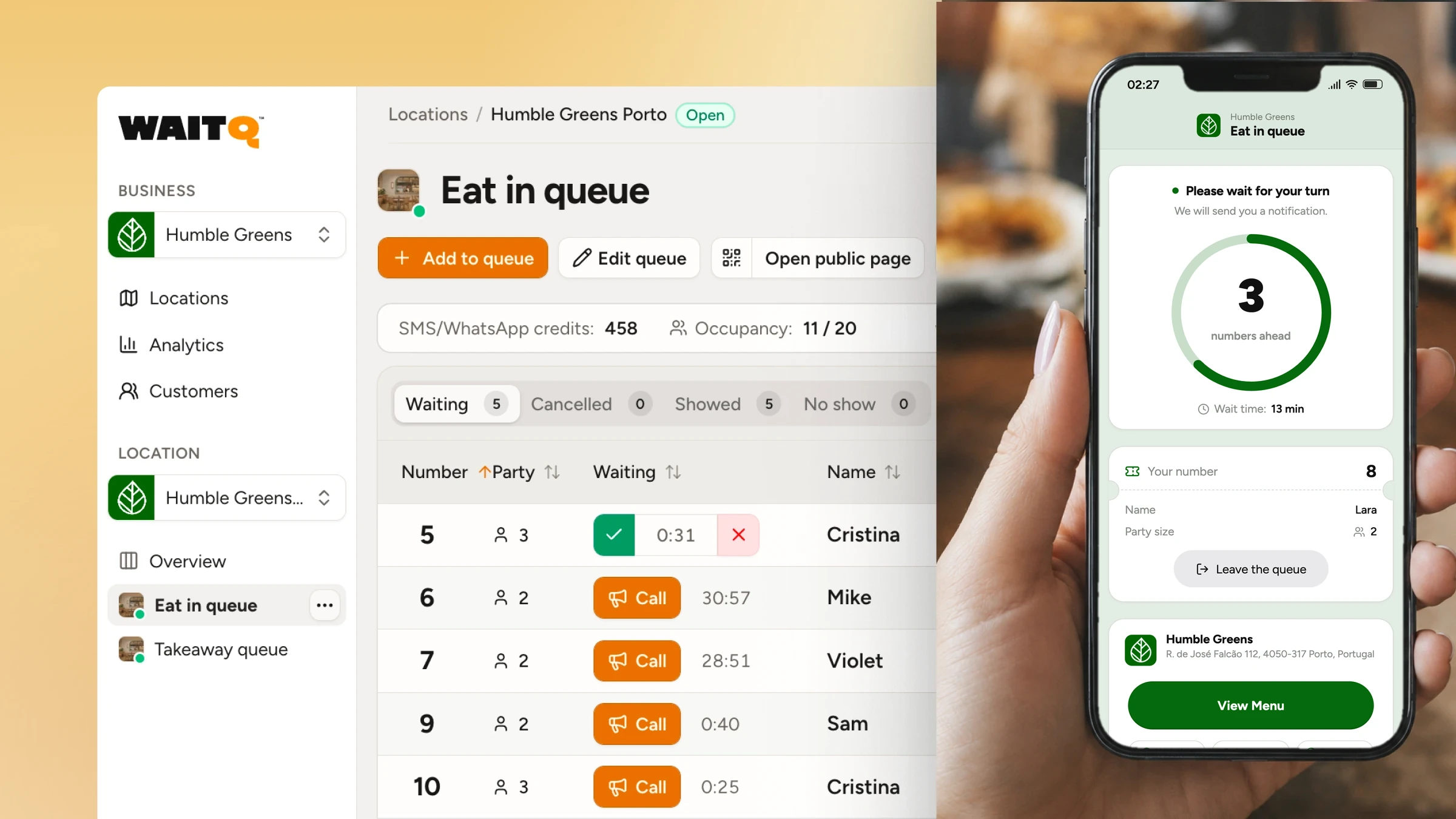
VerdictWaitQ fits restaurants where bookings and walk-ins fill the room on the same night, if you don't mind having no deposits, card holds or diner marketplace.
- Starting price
- $27/month
- Cover fees
- None
- Walk-in waitlist
- Every plan, guests join by QR
WaitQ is a cloud platform for walk-in waitlists, bookings and guest lists, used by restaurants, hotels, salons and clinics.
Guests book a table ahead, or scan a QR code at the door to join the restaurant waitlist on their own phone, with no app download. They see their live position and estimated wait, step away from the door, and get called when the table is ready. Bookings and the waitlist share one floor plan, so the host sees who's booked, who's waiting and which tables are free on one screen.
Pros & Cons
Highlights
- Guests join the waitlist themselves by QR code or kiosk on every plan
- Bookings and walk-ins share one floor plan
- Unlimited visits and bookings on every plan, with no cover fees
- Push notifications, text message (SMS & WhatsApp) and email, and push doesn't use SMS credits
- Published per-location pricing for groups
What to watch out for
- No deposits, prepayments or card holds
- No diner marketplace, so WaitQ won't send you new diners
- No Reserve with Google yet
- Table management starts on the Grow plan
- Integrations start on the Business plan
Pricing
WaitQ costs $27/month for Starter (1 location, 100 SMS and WhatsApp credits), $49/month for Grow (2 locations, table management, 400 credits) and $119/month for Business (5 locations, integrations and API, 1,000 credits), billed annually. Every plan has a 7-day free trial (WaitQ pricing).
Resy
Best for marketplace bookings at a flat price
VerdictResy suits US restaurants that want marketplace exposure at a flat price with no cover fees, if you don't mind a $289/month entry price and a remote waitlist that needs the Resy app.
- Starting price
- $289/month
- Cover fees
- None
- Walk-in waitlist
- Every plan, remote join in the Resy app
Restaurants get listed in the Resy diner app, with bookings, table management and a walk-in waitlist on every plan. Guests can join the waitlist remotely, but only through the Resy app. Resy and Tock now sell their plans on one shared pricing page.
At $289 a month before the first booking, Resy costs more than most flat-priced tools here. That premium buys a place in the Resy app, so it makes sense when Resy's audience is the reason you're signing up.
Pros & Cons
Highlights
- No per-cover fees
- Walk-in waitlist and table management on every plan
- POS integrations on Platform
- Card holds and cancellation fees
What to watch out for
- Entry price of $289/month, tied with Tock for the highest flat entry price here
- Remote waitlist join needs the Resy app
- Deposits are only on the Tock-powered plans
- Advanced analytics start on Platform 360 at $459/month
Pricing
Resy Platform costs $289/month and Platform 360 costs $459/month, with no per-cover fees. Standard payment processing fees apply on top.
Tock
Best for prepaid menus and experiences
VerdictTock is built for restaurants that sell prepaid tasting menus, ticketed events and experiences, and takes a share of every prepayment.
- Starting price
- $289/month
- Cover fees
- None, 2% to 3% on prepayments
- Walk-in waitlist
- Same-day online waitlist
Prepaid bookings, deposits and a walk-in waitlist come on both plans, which now sit on the same pricing page as Resy. Guests can join the same-day waitlist from the restaurant's Tock page or app.
If prepayment isn't central to how you sell seats, the $289 entry price and the cut of every prepayment pay for features you won't use.
Pros & Cons
Highlights
- Prepayment, deposits and card holds for every booking type
- Ticketed events and experiences
- Online walk-in waitlist included
- Lower prepayment fee on Premium
What to watch out for
- 3% fee on prepayments on Essential and 2% on Premium, on top of payment processing
- Starting price of $289/month is high for restaurants that rarely take prepayments
Pricing
Tock Essential costs $289/month plus 3% on prepayments, and Premium costs $459/month plus 2% on prepayments.
SevenRooms
Best for groups that want a guest CRM
VerdictSevenRooms is aimed at restaurant groups that want a guest CRM and marketing automation alongside bookings, priced through a sales process.
- Starting price
- Quote only
- Cover fees
- None, setup fee
- Walk-in waitlist
- QR code and Google
The platform covers bookings, a waitlist guests can join by QR code or through Google, guest profiles and automated campaigns. With no prices on the website, you can't run the cost comparison above until you've sat through a demo.
Pros & Cons
Highlights
- Walk-ins and reservations shown side by side
- Guests join the waitlist by QR code or Google without staff
- Real-time SMS wait updates
- Guest profiles and marketing automation
What to watch out for
- No public pricing, so costs can't be compared without a sales call
- Setup fee and a transaction fee on prepaid bookings
- Sized for groups more than single-location independents
Pricing
SevenRooms sells Starter, Growth and Premium plans on a quote. There are no per-cover fees, but a setup fee and a transaction fee on prepaid widget bookings apply.
Yelp Guest Manager
Best for restaurants with Yelp traffic
VerdictYelp Guest Manager fits US restaurants that already get diners from Yelp, with a flat fee and no cover fees, until the Basic cap kicks in.
- Starting price
- $129/month
- Cover fees
- None
- Walk-in waitlist
- Every plan, join from Yelp or Google
Your tables become bookable on Yelp and partner sites, with bookings and a waitlist on a flat monthly fee and no cover fees.
Watch the Basic cap. A restaurant seating 20 booked covers a night passes 500 in under a month, and the jump to Plus more than doubles the bill.
Pros & Cons
Highlights
- No cover fees on any plan
- Bookings and waitlist on Basic
- Floor plan, card holds and POS integration on Plus
What to watch out for
- Basic caps you at 500 covers a month
- Annual contracts carry a $600 (Basic) or $1,500 (Plus) early termination fee
- No deposits or prepayments listed
- The kiosk is a $99/month add-on, and AI phone answering through Yelp Host is a separate subscription
Pricing
Yelp Guest Manager Basic costs $129/month billed annually ($159 monthly) for up to 500 covers a month. Plus costs $279/month billed annually ($349 monthly) with unlimited covers. Enterprise is quoted.
Eat App
Best for booking-led restaurants starting free
VerdictEat App suits booking-led restaurants that want to start on a free plan, with costs that climb once you need the online waitlist, deposits or POS.
- Starting price
- Free, paid from $69/month
- Cover fees
- None
- Walk-in waitlist
- Staff-run, QR on Pro
Eat App runs bookings, table management and a waitlist, with no cover fees on any plan. On Lite and Core the host adds walk-ins by hand; guests only join themselves, by QR code or online, on Pro and Enterprise.
The free plan is easy to start on. Costs climb on the paid plans, where the online waitlist and deposits need Pro, and POS and payment integrations are paid add-ons on Core.
Pros & Cons
Highlights
- Free plan up to 100 guests a month
- No cover fees
- Waitlist and table management on every paid plan
- WhatsApp messages included on paid plans
What to watch out for
- Online waitlist and deposits need Pro or Enterprise
- POS and payment integrations cost $39/month each on Core
- SMS overage is billed per message, with rates quoted by sales
- The pricing page lists different limits for the same plan in two places
Pricing
Eat App has a free plan for 100 guests a month. Lite costs $69/month, Core $159/month and Pro $299/month, billed annually. Enterprise is quoted. Paid plans have a 14-day free trial.
Toast Tables
Best for toast POS restaurants
VerdictToast Tables makes sense only for restaurants already running Toast POS, where table and order status live in one system.
- Starting price
- $199/month for Plus
- Cover fees
- None
- Walk-in waitlist
- QR, website and Google
The waitlist, bookings and table status live inside the Toast system, so hosts see order and course status next to each table. Guests join the waitlist from a QR code, your website or Google.
Pros & Cons
Highlights
- Table and order status in one system with the POS
- Guests join the waitlist online from a QR code, your website or Google
- Deposits, prepayments and cancellation fees
- Unlimited bookings on Plus
What to watch out for
- Requires an active Toast POS subscription
- The base Toast Tables plan allows 25 bookings a month
- Toast's product and pricing pages don't list the price
- In Canada, the UK and Ireland, you sign up through Toast Customer Care
Pricing
Toast Tables Plus costs $199/month with unlimited bookings, on top of a Toast POS subscription. Toast publishes that figure in its blog rather than on its pricing page.
TableCheck
Best for hotel restaurants and groups in Asia-Pacific
VerdictTableCheck is aimed at hotel restaurants and restaurant groups, with its strongest footprint in Asia-Pacific and pricing through a demo.
- Starting price
- Quote only
- Cover fees
- None on direct bookings
- Walk-in waitlist
- QR or SMS sign-up
The platform brings bookings from web, phone, marketplaces and walk-ins into one book, with a door waitlist and guest profiles. Walk-ins sign up by QR code or SMS and get a text when the table is ready.
Pros & Cons
Highlights
- QR sign-up for walk-ins, with SMS when the table is ready
- Walk-ins saved as guest profiles
- Prepaid courses and cancellation charges
- Booking pages in many languages
What to watch out for
- No public pricing
- Sized for groups and hotels more than independents
- Setup fee charged on top of the monthly license
Pricing
TableCheck quotes pricing after a demo, with a separate setup fee.
ResDiary
Best for UK and Australian independents
VerdictResDiary fits UK and Australian independents that want commission-free bookings, if you don't mind plans capped by monthly bookings and a 1.2% surcharge on deposits.
- Starting price
- £109/month + VAT
- Cover fees
- None
- Walk-in waitlist
- Staff-run
Every ResDiary plan has the same features, and the price rises with your monthly booking count. Staff add walk-ins to the waitlist; guests can only put themselves on a standby list when you're fully booked.
ResDiary's caps count bookings, so a party of six uses one booking from your allowance. A restaurant that seats a lot of groups of six gets far more covers out of each tier than a bistro full of tables for two.
Pros & Cons
Highlights
- No commission on bookings
- Same features on every plan
- Reserve with Google and Meta bookings
- Waitlist with SMS updates for guests
What to watch out for
- Plans cap monthly bookings below Ultimate
- £99 setup fee in the UK
- Prices exclude 20% VAT, and deposits carry a 1.2% surcharge
- Extras like CRM and PMS integrations are monthly add-ons
Pricing
In the UK, ResDiary costs £109/month + VAT for up to 150 bookings (Evo Connect), £145 for 450 (Evo Express), £205 for 1,000 (Evo Pro) and £295 for unlimited bookings (Evo Ultimate), plus a £99 setup fee.
TheFork Manager
Best for european restaurants on TheFork
VerdictTheFork Manager suits European restaurants that want bookings from TheFork's diner marketplace, paid for with a commission on every TheFork guest.
- Starting price
- Quote only
- Cover fees
- Commission on TheFork bookings
- Walk-in waitlist
- Only when fully booked
The software lists your restaurant on TheFork and Tripadvisor and runs bookings, a floor plan and no-show tools. Bookings through your own website widget and social channels carry no commission. TheFork's online waitlist opens only when you're fully booked, so walk-ins at the door need a separate process.
Pros & Cons
Highlights
- Listing on TheFork and Tripadvisor
- Commission-free bookings through your own website widget
- Card guarantees, prepayments and reconfirmations on Performance
- Waitlist when the restaurant is fully booked
What to watch out for
- No public pricing on any plan
- Commission on every guest who books through TheFork
- The waitlist covers fully booked times, with no walk-in waitlist at the door
- Smart floor plan and no-show tools start on Performance
Pricing
TheFork Manager sells Performance and Enterprise plans on a quote, plus a commission on guests who book through TheFork.
Restaurant reservation software compared side by side
Most tools here now let walk-ins join the waitlist themselves, but only some do it on every plan without an app. OpenTable and TheFork are the two that charge for marketplace diners, and WaitQ is the only one without deposits or card holds.
| Best for | |||||||||
|---|---|---|---|---|---|---|---|---|---|
| OpenTable | $149/month | Marketplace bookings | ✕$1 to $1.50 per network cover | Core and Pro (Partial) | Core and Pro (Partial) | ✓Every plan | ✓Three plans listed | ✓OpenTable network | ✕Grows with network covers |
| WaitQ | $27/month | Bookings and walk-ins on one floor plan | ✓No cover fees | ✓QR, link or kiosk | Floor plan from Grow (Partial) | ✕Not yet | ✓On the pricing page | ✕Your own booking page | ✓Unlimited visits |
| Resy | $289/month | Marketplace bookings at a flat price | ✓No cover fees | Resy app only (Partial) | ✓Every plan | Card holds, no deposits (Partial) | ✓Plans listed with prices | ✓Resy app | ✓No cover cap |
| Tock | $289/month | Prepaid menus and experiences | ✓3% or 2% on prepayments | ✓Tock page or app, same day | ✓Full floor plan | ✓Deposits, prepayments, card holds | ✓Plans listed with prices | ✓Tock site and app | ✓No cover cap |
| SevenRooms | Quote only | Groups that want a guest CRM | ✓Setup and prepay fees | ✓QR or Google | ✓One floor view | ✓Card holds, cancellation fees | ✕Quote only | ✓DoorDash and Deliveroo Reservations | Quoted per restaurant (Partial) |
| Yelp Guest Manager | $129/month | Restaurants with Yelp traffic | ✓No cover fees | ✓Yelp, Google, Apple Maps | Floor plan on Plus (Partial) | Card holds on Plus (Partial) | ✓Basic and Plus listed | ✓Yelp | ✕Basic caps 500 covers |
| Eat App | Free, paid from $69/month | Booking-led restaurants starting free | ✓No cover fees | Pro and Enterprise (Partial) | ✓Every plan | Pro and Enterprise (Partial) | ✓All tiers but Enterprise | ✓eatapp.co diner site | ✓Paid plans uncapped |
| Toast Tables | $199/month for Plus | Toast POS restaurants | ✓Same price at any volume | ✓QR, website, Google | ✓Live floor plan | ✓Deposits, prepayments, fees | Price in Toast's blog only (Partial) | ✓Toast Local app | ✕Base tier: 25 bookings |
| TableCheck | Quote only | Hotel restaurants and groups in Asia-Pacific | None on direct bookings (Partial) | ✓QR or SMS sign-up | ✓Walk-ins in one book | ✓Deposits, holds, cancellation fees | ✕Demo only | ✓TableCheck site and app | Quoted per restaurant (Partial) |
| ResDiary | £109/month + VAT | UK and Australian independents | ✓1.2% on deposits only | Standby list when full (Partial) | ✓Table plan with walk-ins | ✓1.2% surcharge | ✓Four plans listed | Via DesignMyNight (Partial) | ✕Priced by bookings |
| TheFork Manager | Quote only | European restaurants on TheFork | ✕Commission per TheFork guest | Only when fully booked (Partial) | Smart floor plan on Performance (Partial) | Performance plan (Partial) | ✕Ask for pricing | ✓TheFork and Tripadvisor | ✕Commission grows with bookings |
Partial means the feature exists with limits, on some plans or as a paid add-on.
What does a restaurant reservation system cost?
A restaurant reservation system costs between $0 and about $500 a month in subscription fees, before cover fees and add-ons. At 1,000 covers a month, the real cost of the same job ranges from under $100 to about $700, depending mostly on whether the tool charges per cover.
Per-cover fees vs flat pricing
Per-cover fees are charged for every diner in the party, so a booking for four counts as four covers. OpenTable charges $1.50 per network cover on Basic and $1 per network cover on Core and Pro, for diners who find you through OpenTable's site, app or partners. Website bookings on Basic cost $0.25 per cover or a flat $49 a month. Phone bookings and walk-ins carry no fee on any plan. TheFork works the same way in spirit, with a commission on every guest who books through TheFork.
Flat pricing charges the same amount whatever your volume. WaitQ, Resy, Tock, Yelp Guest Manager, Eat App and ResDiary all use flat monthly plans. Some cap the volume instead: Yelp Guest Manager Basic stops at 500 covers a month, and ResDiary prices its plans by monthly booking count.
Real monthly cost at 1,000 covers
The table below prices the plan each tool needs for bookings, a walk-in waitlist and table management at 1,000 covers a month. For OpenTable we assumed 400 of those covers come through its marketplace.
| Tool | Plan needed | Subscription | Cover or volume fees | POS integration | Monthly total |
| WaitQ | Grow | $49 | $0 | Integrations on Business ($119) | $49 |
| Eat App | Core | $159 | $0 | +$39 add-on | $159 to $198 |
| Toast Tables | Plus | $199 | $0 | Requires Toast POS | $199 + Toast POS |
| Yelp Guest Manager | Plus | $279 | $0 | Included on Plus | $279 |
| Resy | Platform | $289 | $0 | Included | $289 |
| Tock | Essential | $289 | 3% on prepayments | Listed on Premium ($459) | $289 + prepay fees |
| OpenTable | Core | $299 | $400 (400 × $1) | Included | $699 |
| ResDiary | Evo Express (up to 450 bookings) | £145 + VAT | £0 | Add-on | £145 + VAT, £99 setup |
| SevenRooms, TableCheck, TheFork | Quoted | Quoted | Varies | Varies | Ask sales |
One location, list prices checked November 2026, at the annual rate where the vendor offers one (WaitQ, Eat App, Yelp) and the monthly rate otherwise. Yelp Guest Manager Basic covers up to 500 covers a month, so 1,000 covers needs Plus. Eat App's pricing page lists different limits for the same plan in two places, so we used Core.
At 3,000 covers with 1,200 from the marketplace, OpenTable Core reaches $1,499 a month, while every flat-priced tool in the table stays where it was. With per-cover pricing, your best month is also your most expensive month for software.
Costs that don't appear on the pricing page
- Text message overage. Most tools include a monthly allowance of SMS or WhatsApp messages and bill extra messages at local carrier rates. Eat App bills overage per message and quotes the rate through sales. WaitQ includes 100 to 1,000 credits a month depending on plan, and push notifications don't use them.
- POS integration. Eat App charges $39 a month for POS on Core. Yelp keeps POS for Plus. WaitQ has integrations on Business.
- Prepayment fees. Tock takes 3% on Essential and 2% on Premium. OpenTable takes 2% on prepaid experiences and ticketing. ResDiary adds a 1.2% surcharge on deposits.
- Setup fees. ResDiary charges £99 in the UK, and SevenRooms and TableCheck charge setup fees on top of the license.
- Early cancellation fees. Yelp Guest Manager's annual contracts carry a $600 fee on Basic and $1,500 on Plus if you cancel during the 12-month term.
How do restaurant reservation systems handle walk-ins?
Every tool on this list has a waitlist. On some plans the host types each walk-in's name and number into a tablet while the next party waits behind them. On others the guest scans a QR code, joins from their own phone and wanders off until the table is ready.
In research on 94,404 restaurant visits, the average walk-in party was two people and most were first-time visitors. A first-time party of two has no booking history with you and very little reason to stay if the host stand looks chaotic.
| Tool | Guests join without staff | Join from a link or Google | How guests are notified |
| WaitQ | ✓ QR code and kiosk, all plans | ✓ Link on all plans | Push notifications, text message (SMS & WhatsApp) and email |
| OpenTable | ✓ Online waitlist on Core and Pro | ✓ Core and Pro | Direct messaging on Core and Pro |
| Resy | Partial: remote join in the Resy app | ✕ | Automated guest alerts |
| Tock | ✓ Same-day online waitlist | ✓ Tock page or app | Automated guest alerts |
| SevenRooms | ✓ QR code | SMS | |
| Yelp Guest Manager | ✓ Online waitlist | ✓ Yelp, Google and Apple Maps | Two-way texting |
| Eat App | Partial: Pro and Enterprise only | Partial: Pro and Enterprise | SMS, WhatsApp and email |
| Toast Tables | ✓ QR code | ✓ Website and Google | SMS |
| TableCheck | ✓ QR sign-up | Partial: SMS sign-up | SMS |
| ResDiary | ✕ Staff add walk-ins | Partial: standby list when fully booked | SMS |
| TheFork Manager | ✕ Staff add walk-ins | Partial: only when fully booked | Only for the fully booked waitlist |
Letting guests wait away from the door changes how the wait feels. In a study of restaurants that moved walk-ins to a digital queue, complaints about the wait before seating fell by 24.7%. In 2026 internal data from WaitQ customers, 3 in 4 restaurant guests joined the waitlist themselves by scanning a QR code, with no staff involved.
If walk-ins are a big share of your covers, test two things in any demo. Can a guest join without a host typing anything? And when a walk-in and a booking want the same table, does the system show both on the same floor plan? If the vendor can't show you the first one live, assume your host will be typing every name in by hand. Restaurants that run both usually set buffer windows before each booking so a walk-in never sits at a table that's due in 20 minutes.
Marketplace vs direct bookings: who owns the guest data?
Marketplace platforms list your restaurant inside a diner app. OpenTable, Resy, Tock, Yelp and TheFork all work this way. The marketplace sends you diners you wouldn't otherwise reach, and in exchange the diner's account lives with the platform. OpenTable charges for each of those diners on every plan.
Direct booking tools put a booking page on your own website, Instagram profile and Google listing. WaitQ and ResDiary work this way, and TableCheck and Eat App run a direct channel next to their diner sites. You keep the guest's details, and you do your own marketing to bring diners in.
Running both is normal, and the split is worth planning. Let the marketplace find new diners, then give regulars a direct booking link on a branded check-in page with your own logo and colors. On OpenTable, a regular who books through the app costs you a cover fee every visit, and the same regular booking through your website costs nothing on Core and Pro.
Which restaurant reservation system should you choose?
Choose by how your room fills and what you need the software to do. Marketplace-led restaurants fit OpenTable or Resy, tasting-menu rooms fit Tock, groups that want a guest CRM fit SevenRooms, and restaurants with bookings and walk-ins every night fit WaitQ. Deciding how much of the room to hold for reservations versus the waitlist comes before picking the tool.
| Your restaurant | What to look for | Best fit |
|---|---|---|
| You take bookings and walk-ins every night | Look for bookings and a self-serve waitlist on one floor plan, with no cover fees. WaitQ covers both; if you also need deposits and already run Toast POS, Toast Tables handles both. | WaitQorToast Tables |
| You rely on marketplace diners | Run the cover math before you sign. OpenTable has the bigger network and charges per cover; Resy charges a flat fee. | OpenTableorResy |
| You sell tasting menus or prepaid experiences | Look for prepayment on every booking type. Tock's fee drops from 3% to 2% on Premium. | Tock |
| You run a restaurant group and want guest marketing | Look for a guest CRM and campaigns. Budget time for a sales process, since neither publishes prices. | SevenRoomsorTableCheck |
| You want to reach guests on WhatsApp | Look for WhatsApp in the plan, not as a paid add-on. WaitQ sends WhatsApp from the SMS and WhatsApp credits on every plan, and Eat App includes WhatsApp on its paid plans. | WaitQorEat App |
| You're just starting to take bookings online | Start on a free plan, then price the add-ons before you upgrade. Eat App's free plan covers up to 100 guests a month. | Eat App |
Conclusion
Picking a reservation system mostly comes down to whether you need someone else's diners. Marketplaces like OpenTable, Resy and TheFork bring in guests you wouldn't reach on your own, and you pay for that with cover fees, plan caps or a guest relationship that lives on their app. Direct booking tools get cheaper per guest as you grow and keep the data with you, and every diner has to come from your own website, Instagram or front door.
WaitQ fits when a big share of your covers walk in, because guests join the waitlist from their own phone and bookings sit on the same floor plan. WaitQ doesn't take deposits yet, so a tasting-menu room that lives on prepayment will be better served by Tock. If that's your room, the WaitQ pricing page shows which plan adds table management, so you can test it on a real service before you commit.
